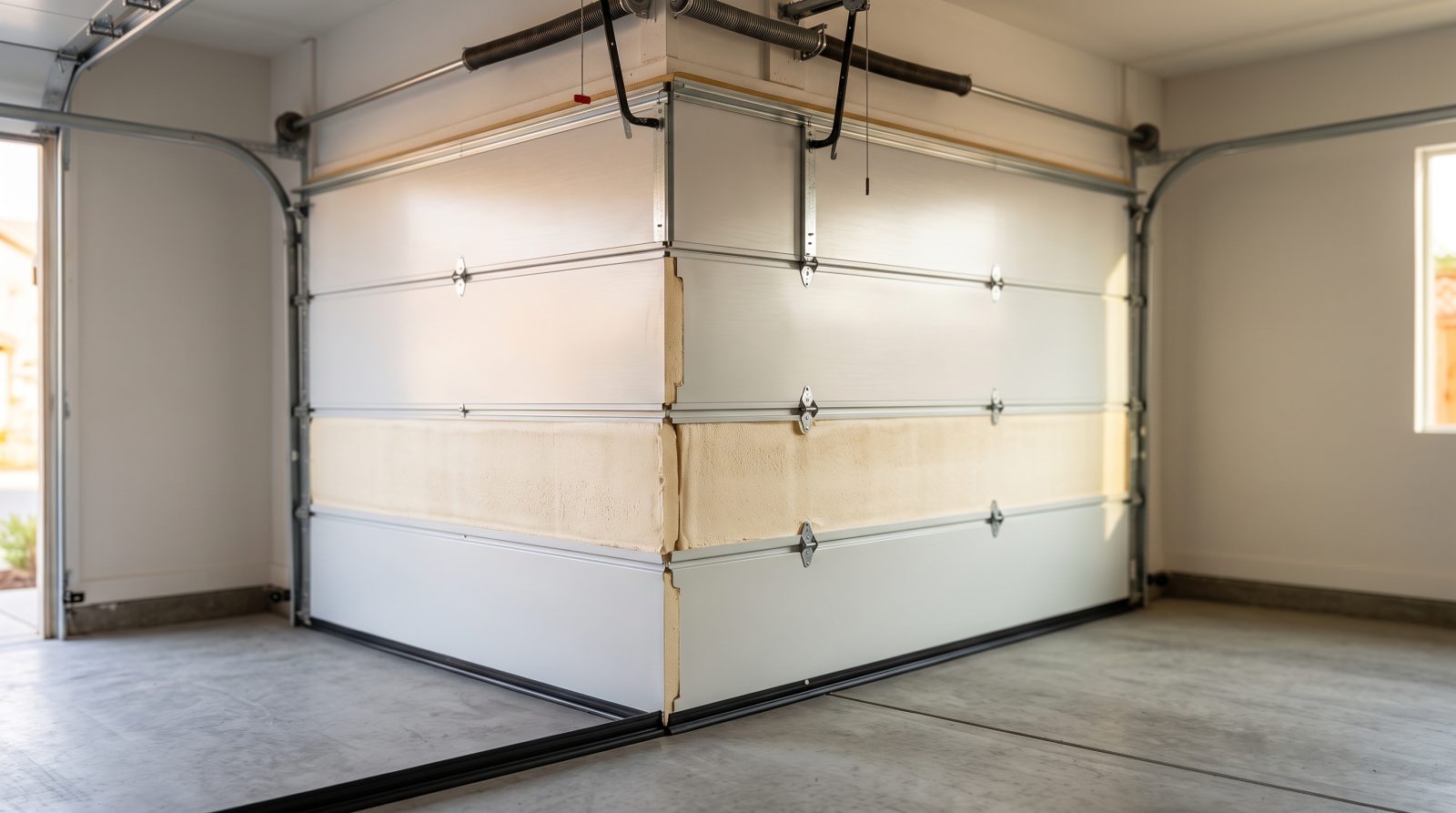
Why Garage Door Insulation Matters More in Sacramento Than Almost Anywhere
Sacramento's climate is uniquely hard on garage doors. Summer highs routinely sit in the upper 90s and break 100 degrees for stretches in July and August, and a west- or south-facing door takes the full force of that afternoon sun. Steel conducts heat efficiently, so an uninsulated door behaves like a radiator: it absorbs solar energy all day and re-emits it into the garage well into the evening, often long after the Delta breeze has started cooling everything else down. If your garage shares a wall or ceiling with a bedroom, office, or bonus room, that heat migrates indoors and forces your HVAC to fight a losing battle.
The way Sacramento homeowners actually use their garages makes this worse. Across neighborhoods from Natomas to Elk Grove to East Sacramento, garages have become home gyms, workshops, home offices, second refrigerators and freezers, and storage for things that do not like heat. An uninsulated, sun-baked garage can swing 30 to 40 degrees hotter than the shaded north side of the house, which is brutal for a workout space and quietly expensive for a chest freezer running flat-out against the heat. Insulation narrows that swing in both directions, holding the garage cooler in summer and taking the edge off cold winter mornings.
There is also a comfort-and-noise dimension people underestimate. An insulated door is structurally stiffer and quieter, dampening street noise, the rumble of the door itself, and the racket of a workout or power tools. For the growing number of Sacramento garages doing double duty as livable space, that acoustic benefit is often as valued as the temperature control.
- Direct afternoon sun on west/south-facing doors drives extreme heat gain on 100-degree Valley days
- Heat radiates from steel doors for hours, undermining evening cooling from the Delta breeze
- Shared walls and ceilings push garage heat into adjacent bedrooms, offices, and bonus rooms
- Garages used as gyms, workshops, and offices need a far tighter temperature range
- Freezers, refrigerators, and heat-sensitive storage run harder and cost more in a hot garage
- Insulated doors are noticeably quieter and stiffer, which matters for livable garage space
R-Value Explained Without the Marketing Spin
R-value measures how well a material resists heat flow: the higher the number, the slower heat moves through it. For garage doors you will see ratings that typically range from about R-6 on a thin insulated panel up to R-18 or higher on premium polyurethane doors. It is a useful number, but it is also the single most over-marketed spec in the industry, so it pays to understand what it does and does not tell you.
The biggest catch is the difference between center-of-panel R-value and whole-door performance. Manufacturers usually advertise the R-value measured at the thickest, best-insulated point in the middle of a panel. The real door also has thinner edges, seams between sections, and gaps around the perimeter where heat and air sneak through. A door advertised at R-16 might deliver effective performance closer to the low teens once you account for the whole assembly. That is not necessarily dishonest, but it means you should treat the headline number as a comparison tool between similar products, not a literal promise.
For most Sacramento homes, the law of diminishing returns kicks in sooner than you might expect. Going from zero insulation (a bare single-layer door) to a solid mid-range insulated door is a dramatic, easily felt improvement. Climbing from a good mid-range door to the absolute top-tier rating is a much smaller real-world gain, and it mostly matters if the garage is conditioned living space or you run heating and cooling out there. Also remember the door is one surface among many: an insulated door on an otherwise leaky, uninsulated garage with a gappy bottom seal and an uninsulated ceiling will underperform, because heat simply takes the path of least resistance.
- R-value = resistance to heat flow; higher is better, but context matters
- Advertised numbers are usually center-of-panel, not whole-door performance
- Edges, seams, and perimeter gaps lower real-world effectiveness below the headline R-value
- Biggest gains come from going zero-to-insulated; top-tier upgrades show diminishing returns
- Whole-garage weak points (seals, ceiling, walls) can cancel out a high door R-value
The Main Insulation Methods, Honestly Compared
There are three realistic paths to an insulated garage door, and the right one depends on your existing door, your budget, and how you use the space. The first is a DIY or professionally installed insulation kit applied to your current door. These usually use rigid foam board (polystyrene) panels or vinyl-faced fiberglass batts cut to fit each door section and held in place with retainer clips or adhesive. Kits are the most affordable route and can meaningfully reduce heat transfer on a bare steel door. The trade-offs: they add weight that can throw off your door's spring balance, they rarely look as clean as a factory door, and the fit around panel edges is never perfect, so performance is good rather than great.
The second path is a polystyrene (EPS) insulated door from the factory. These sandwich a layer of rigid foam between steel skins and land in the lower-to-mid R-value range. They are a strong value choice for most Sacramento homeowners who want real, durable insulation without premium pricing, and the foam is bonded as part of a sealed assembly so there are no loose panels to rattle or sag over time.
The third and best-performing path is a polyurethane insulated door. Here, liquid polyurethane is injected between the steel skins and expands to fill every void, bonding the layers into a single rigid unit. This delivers the highest R-values, the best structural rigidity, the quietest operation, and the longest-lasting performance because there are no gaps for heat to find. It is the premium option and priced accordingly, but for a sun-blasted door on a garage you actually live in, it is usually the upgrade that pays off in comfort. Whatever path you choose, balance matters enormously: any insulation you add changes the door's weight, and the springs and opener must be matched to it. That is the part most worth having a professional verify.
- Insulation kits (foam board or fiberglass batts): lowest cost, retrofit your existing door, decent but imperfect results
- Kits add weight that can unbalance springs and may rattle or sag over time
- Polystyrene (EPS) insulated doors: foam-core factory doors, great value, sealed and durable
- Polyurethane insulated doors: injected foam, highest R-value, stiffest and quietest, premium price
- Any added insulation changes door weight, so spring tension and opener force must be re-checked
Weather Sealing: The Cheap Step That Makes Insulation Actually Work
Insulation slows heat moving through the door's surface, but it does nothing about air leaking around the edges, and in Sacramento that air leakage is often the bigger problem. A door can have an impressive R-value and still bleed hot afternoon air through a worn bottom seal, cracked perimeter weatherstripping, and gaps at the section joints. Sealing is inexpensive, fast, and frequently delivers a comfort improvement out of proportion to its cost, which is why we treat it as part of any serious insulation conversation rather than an afterthought.
The most important seal is the bottom astragal, the flexible gasket that presses against the garage floor. Concrete slabs across Sacramento are rarely perfectly level, and over years of heat and use that bottom seal hardens, splits, and stops conforming to the floor, leaving a gap that lets in hot air, dust, water during winter storms, and the occasional pest. Replacing it is one of the quickest wins available. Beyond the bottom, perimeter weatherstripping along the jambs and header, vinyl or rubber stop molding, and seals between the door sections all matter. On older homes in areas like Land Park, Curtis Park, and Oak Park, that perimeter stripping is often original and brittle, and refreshing it restores a tight envelope.
Sealing also protects the rest of your investment. A tight perimeter keeps the conditioned or insulated air you are trying to hold from escaping, keeps wind-driven summer dust out of a garage gym or workshop, and reduces the moisture intrusion that rusts hardware and warps stored items. When we assess a door on-site, the seals are one of the first things we inspect, because an insulated door with bad seals is a half-finished job.
- Air leakage around the edges often matters more than the door's surface R-value
- The bottom astragal seal is the top priority; uneven Sacramento slabs cause gaps as it ages
- Perimeter weatherstripping on jambs and header seals the door against the frame
- Section-to-section seals close the joints between panels
- Older neighborhood homes frequently have brittle, original stripping worth replacing
- Good seals keep out summer dust and winter moisture and protect hardware from rust
What to Realistically Expect, Plus Costs and the Balance Warning
It helps to set honest expectations. Insulating a garage door is not the same as air-conditioning the garage. What insulation reliably does is reduce heat transfer, narrow the daily temperature swing, take the harshest edge off summer afternoons and winter mornings, cut noise, and make the space far more usable. If your goal is to keep a garage gym from becoming unbearable by 3 p.m. in July, a well-insulated and well-sealed door is a major step. If your goal is to hold a precise temperature for a conditioned room, the door needs to be paired with an insulated ceiling, walls, and a sealed envelope to truly perform.
On cost, treat all figures as general industry ranges, not quotes, because the right number depends on your door size, material, condition, and what your springs and opener need afterward. Insulation kits applied to an existing door sit at the low end. A new factory polystyrene insulated door is a mid-range investment. A premium polyurethane insulated door, especially in larger two-car widths, sits at the upper end. Replacing seals and weatherstripping is inexpensive and often the smartest first money you spend. The only way to get a real number for your situation is an on-site look, and you can request a free quote anytime.
The most important technical caution is balance. Springs are sized to counterbalance a specific door weight. When you add insulation, whether through a kit or a new heavier door, the system has to be matched to that new weight, or you risk a door that strains the opener, will not stay open, or puts dangerous load on worn springs. This is the part where the we-come-to-you advantage really shows: a mobile technician can weigh and balance the door, adjust spring tension, and confirm the opener's force settings are correct on the spot. Doing the insulation right and the balance right together is what turns a good idea into a door that performs and lasts.
- Insulation reduces heat transfer and noise; it is not the same as air-conditioning the garage
- For a truly conditioned room, pair the door with insulated walls, ceiling, and a sealed envelope
- Cost guidance (industry ranges, not quotes): kits = low end, polystyrene door = mid, polyurethane door = high
- New seals and weatherstripping are the cheapest, highest-value starting point
- Added insulation changes door weight; springs and opener must be re-balanced and re-checked
- An on-site assessment is the only way to get accurate pricing and a safe, balanced result