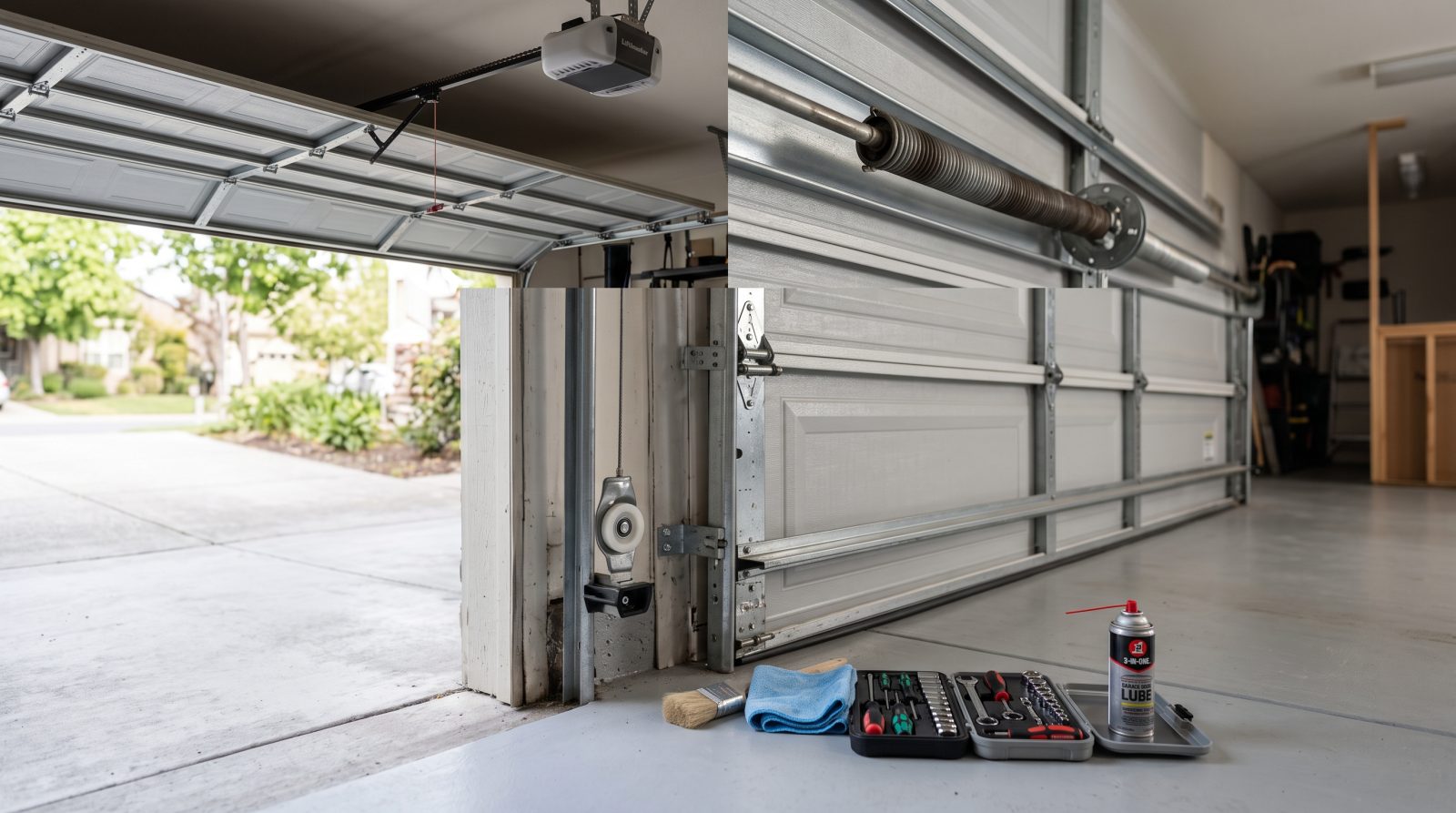
Why Sacramento's Climate Is Hard on Garage Doors
Maintenance advice written for a mild coastal climate doesn't fully apply here. The Sacramento region puts a specific set of stresses on a garage door system, and understanding them tells you what to inspect and how often. Our long, dry summers regularly push past 100 degrees, and an attached garage with a metal or sectional door can become an oven that bakes lubricants dry and makes weatherstripping brittle. The same heat causes metal tracks, rollers, and torsion hardware to expand and contract daily, slowly loosening fasteners that were perfectly tight in spring.
Winter brings the opposite challenge. Tule fog and damp, cool air settle into the Valley for weeks at a time, and that moisture is what rusts springs, hinges, and the bottoms of steel tracks, especially in older Land Park, Oak Park, and East Sacramento garages that sit close to grade. Add in the fine, gritty dust that blows in from surrounding farmland and the American River corridor, and you get an abrasive paste when dust mixes with old grease inside the rollers and bearings.
Finally, in newer communities like Natomas, Elk Grove, Folsom, and Roseville, the garage is often the door the family actually uses every day, cycling four, six, even ten times daily. More cycles mean faster wear on springs and openers. None of this is cause for alarm, but it does mean a 'set it and forget it' approach doesn't hold up locally. A short seasonal routine is the difference between a door that lasts and one that strands you.
- Summer heat: dries out lubricant, embrittles rubber seals, and loosens hardware through thermal cycling
- Winter fog and damp: promotes rust on springs, hinges, fasteners, and track bottoms
- Valley dust: combines with old grease to form an abrasive grinding paste in rollers and bearings
- High daily cycle counts in newer suburbs accelerate spring and opener wear
Your Quick Monthly Check (10 Minutes, No Tools)
Before the seasonal deep-dives, build one easy habit: a quick monthly look and listen. You don't need tools, and you don't need to take anything apart. The goal is simply to notice change, because a door that suddenly sounds different or moves differently is telling you something early. Pick a consistent day, like the first of the month, and run through the same short routine each time.
Start by standing inside the garage and watching the door go up and down once. A healthy door moves smoothly and evenly, without jerking, hesitating, or sagging to one side. New grinding, popping, or scraping noises are the most common early warning sign, and they usually point to dry rollers, a loose hinge, or debris in the track. Then test the door's two critical safety systems, which protect children, pets, and cars and have been required on residential openers manufactured since 1993.
- Watch one full cycle: look for jerking, hesitation, or the door tilting unevenly
- Listen for new grinding, popping, or scraping that wasn't there last month
- Test the auto-reverse: lay a roll of paper towels or a 2x4 flat under the door; it should reverse on contact
- Test the photo-eye sensors: wave an object through the beam while closing; the door should stop and reverse
- Glance at the springs, cables, and rollers for fraying, rust streaks, or visible wear (look only, never touch the springs)
- Check that the photo-eye lenses near the floor are clean and aligned, a common culprit for a door that won't close
Spring & Summer: Beat the Heat Before It Beats Your Door
Spring is the ideal time for your most thorough maintenance of the year, because you're prepping the door to survive the brutal stretch from June through September. The two priorities are lubrication and tightening, both undone by the previous summer's heat and the winter's damp.
For lubrication, use a garage-door-specific lubricant, ideally a silicone or lithium-based spray. Avoid WD-40 as a lubricant: it's a degreaser and a water displacer, so it actually strips away the protective film you want and attracts dust, which is the last thing you need in a dusty Valley garage. Wipe the tracks clean first with a dry cloth (do not grease the inside face of the tracks, the rollers should roll, not slide), then apply lubricant to the rollers, hinges, springs, bearing plates, and the armbar pivot points. A properly lubricated door is dramatically quieter, which neighbors in tighter Elk Grove and Roseville lots will appreciate.
Next, grab a socket wrench and snug up the hardware loosened by thermal cycling: roller brackets, hinge bolts, and the bolts anchoring the track to the wall and ceiling. Tighten firmly but don't overtighten, which can strip threads or crack brackets. Finally, summer is when worn weatherstripping matters most, because the bottom seal keeps the worst of the heat, dust, and the occasional pest out of your garage. If the bottom rubber is cracked, flattened, or letting daylight in, it's a cheap, satisfying DIY replacement that pays off all summer.
- Clean tracks with a dry cloth; do not lubricate the track surface itself
- Lubricate rollers, hinges, springs, bearings, and pivots with silicone or lithium spray, not WD-40
- Tighten roller brackets, hinge bolts, and track mounting hardware with a socket wrench
- Inspect and replace cracked or flattened bottom weatherstripping to seal out heat and dust
- Check and lightly lubricate the opener chain or screw drive per the manufacturer's manual
Fall & Winter: Guard Against Fog, Rust & Damp
When the heat breaks and the fog rolls in, the enemy changes from dryness to moisture. Fall maintenance is about protecting metal parts from rust and making sure the door seals tightly against cool, damp air, especially in older central-city garages where humidity lingers.
Start with a careful visual rust check on the springs, cables, hinges, and the lower few inches of the steel tracks, where moisture collects. Light surface rust on hinges or tracks can be wiped down and re-lubricated to slow it. But if you see rust pitting or, more importantly, any fraying or broken strands on the lift cables, stop and call a professional, because those cables are under extreme tension. A fresh, light coat of the correct lubricant before winter creates a moisture barrier that meaningfully reduces fog-season corrosion.
Then turn to sealing and balance. Re-inspect all the weatherstripping, the bottom seal and the perimeter stop molding, and make sure the door closes flush with no gaps where damp air sneaks in. Test the door's balance: with the opener disconnected via the red release cord, lift the door halfway by hand. A properly balanced door stays roughly in place; if it slams down or flies up, the spring tension is off. Spring adjustment is not a DIY task, but identifying the imbalance yourself means you can have it corrected before a cold snap stresses a weakened spring to failure.
- Inspect springs, cables, hinges, and lower tracks for rust; address light surface rust early
- Stop immediately and call a pro if cables show fraying or broken strands
- Apply a light protective coat of lubricant as a moisture barrier before fog season
- Confirm the door closes flush with intact bottom and perimeter weatherstripping
- Run the balance test with the opener disengaged; note (don't fix) any imbalance for a pro
The One Job to Always Leave to a Pro: Springs & Cables
Almost everything in this guide is genuinely safe to do yourself with a little care. There is one critical exception, and it's important enough to call out on its own: torsion and extension springs, and the lift cables connected to them, are under enormous tension and store a tremendous amount of energy. A spring that lets go, or a cable that slips during an adjustment, can cause serious injury in an instant. It's one of the most common sources of garage door injuries, and it's exactly the kind of repair where the right tools, parts, and experience matter.
Your DIY role with springs and cables is to observe and report, not to adjust or replace. Look for rust, gaps in a coiled spring, frayed cable strands, or a door that's gone heavy or unbalanced, and then bring in a professional. Because we're a mobile garage door company, we come to you anywhere in the Sacramento area with the parts and gear on the truck, so a failed spring doesn't have to mean hauling anything anywhere or leaving your home exposed.
The same 'know your limit' logic applies to a few other situations. If the door is off its tracks, the opener is failing electrically, a panel is damaged, or the door simply won't move and you can't see why, those are good moments to request a free quote rather than force it. Catching issues early through the routine above is what keeps the vast majority of repairs small, and it's the whole point of maintaining the door in the first place.
- Never attempt to adjust, tighten, or replace torsion/extension springs or lift cables yourself
- Treat a sudden heavy, slamming, or unbalanced door as a spring issue for a professional
- Leave off-track doors, electrical opener faults, and damaged panels to a technician
- When in doubt, request a free quote: a mobile tech comes to you with parts on hand
A Printable Seasonal Schedule
To make this stick, here's the whole routine condensed into a simple calendar you can keep on the garage wall. The monthly check takes ten minutes and catches sudden changes. The two seasonal services, one before summer heat and one before winter fog, are where you do the deeper cleaning, lubrication, and inspection. Done consistently, this rhythm matches your maintenance to the exact stresses each Sacramento season brings.
If a check ever turns up something beyond the basics, a frayed cable, a rusted or gapped spring, a door that's lost its balance, or any grinding you can't trace, that's your cue to call in a professional rather than push through it. A quick, same-day mobile visit to your driveway is far cheaper and safer than a door that fails at the worst possible moment.
- Every month: 10-minute look-and-listen plus the two safety tests (auto-reverse and photo-eyes)
- Spring (Mar-Apr): deep clean tracks, full lubrication, tighten all hardware, replace worn bottom seal
- Summer (ongoing): watch for heat-related noise and confirm the seal is keeping heat and dust out
- Fall (Oct-Nov): rust inspection, protective lubricant coat, weatherstripping check, balance test
- Winter (ongoing): listen for fog-season stiffness or rust noise and confirm a flush, sealed close
- Any season: cables, springs, off-track doors, and opener faults go to a pro, request a free quote