What garage door safety sensors actually are
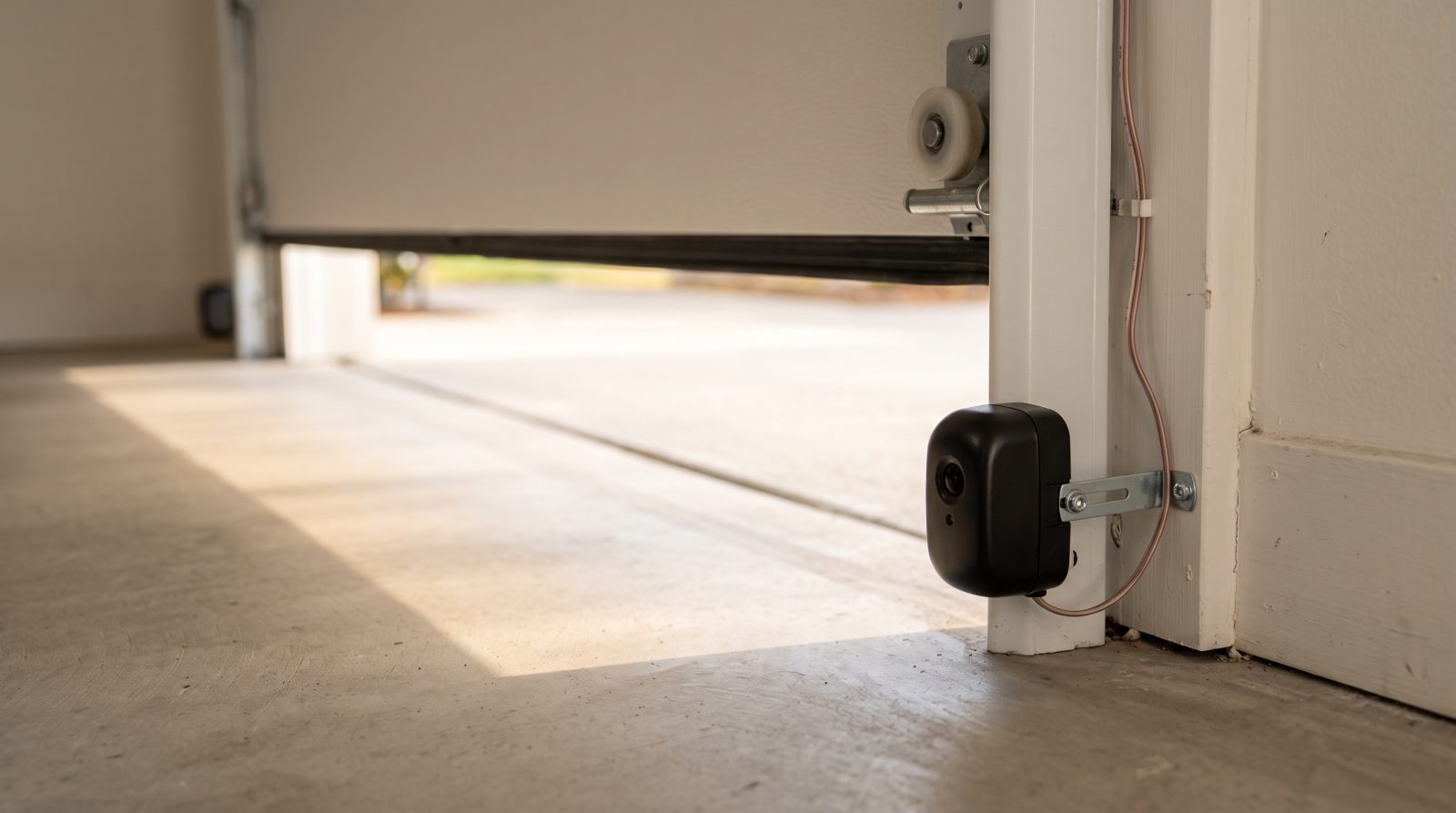
Garage door safety sensors, often called photo-eyes or photoelectric sensors, are a pair of small plastic units mounted near the floor on each side of the door opening, usually about four to six inches above the ground and bolted to the bottom of the vertical tracks. One sensor is a transmitter that sends a continuous invisible infrared beam across the doorway, and the other is a receiver that watches for that beam. As long as the receiver sees the beam, the opener knows the path is clear and allows the door to close. The moment something interrupts the beam, the opener stops the door and reverses it back to the open position.
This system has been a federal safety requirement on residential garage door openers manufactured in the United States since 1993, which is why essentially every modern opener has them. Before photo-eyes existed, garage doors relied only on a contact reverse, meaning the door had to physically bump into an object before it would back off. That was far too late to prevent a tragedy. The photo-eye solved this by detecting an obstruction before the door ever touches it.
It helps to think of the two sensors as a conversation that has to stay uninterrupted. The transmitter is talking, the receiver is listening, and the opener will only let the heavy door descend while it can confirm that conversation is happening cleanly. Anything that breaks the line of sight between the two eyes, or even knocks them slightly out of aim, ends the conversation and the opener responds by refusing to close. Understanding that simple relationship explains almost every sensor problem you will ever run into.
- Transmitter (often an amber or yellow LED): sends the infrared beam
- Receiver (often a green LED): listens for the beam and reports to the opener
- Mounted low, typically 4 to 6 inches off the floor, so they protect the danger zone where a child or pet would be
- Connected back to the opener motor by thin low-voltage wires running up the tracks
- Required by U.S. federal law on residential openers built since 1993
Why the sensors matter more than people think
A typical residential garage door weighs well over a hundred pounds, and many insulated or solid-wood doors weigh considerably more. It is the single largest and heaviest moving object in most homes, and it moves on a daily basis with people, kids, and pets nearby. The safety sensors are the last automatic line of defense that keeps that mass from closing on someone. When they work, they are invisible and you never think about them. When they are disabled, bypassed, or broken, the door loses its ability to know that something is underneath it.
This is exactly why we strongly discourage the common shortcut of taping the sensors to point at each other, propping them so the beam is permanently clear, or jumping the wires so the opener thinks the path is always safe. People do this out of frustration when the door will not close, but it defeats the entire purpose of the device. A door with bypassed sensors will close on a tricycle, a sleeping dog, or a toddler without hesitating. If your sensors are giving you trouble, the right answer is to fix the alignment or replace the part, not to trick the opener into ignoring it.
There is also a separate, mechanical safety feature worth knowing about: auto-reverse on contact. Even with working photo-eyes, a properly adjusted door should reverse if it physically meets resistance on the way down. The two systems back each other up. The photo-eyes catch obstacles in open air before contact, and the contact reverse catches anything the beam missed. A complete safety check tests both.
- The door is the heaviest moving object in most homes and operates daily around family members
- Photo-eyes detect an obstruction before any contact is made, not after
- Never tape, prop, or wire-jump the sensors to force a door to close, it removes the protection entirely
- Auto-reverse on contact is a separate backup safety feature that should also be tested
- A quick monthly test (wave a broom handle through the beam as the door closes) confirms the door reverses
The real reasons your door won't close: alignment and obstruction
When a garage door starts down and then immediately rolls back up, the opener is almost always doing its job correctly, it genuinely believes something is in the way. The skill is in reading why. The most common culprit is misalignment, where one sensor has been bumped, sagged, or twisted so the two eyes are no longer aimed at each other and the beam can no longer reach the receiver. This happens easily because the sensors sit right at shin and bumper height, exactly where a passing car, a bicycle, a rolling trash bin, or a stack of stored boxes can nudge them.
The second big category is a blocked or dirty beam. The infrared light is invisible to us but it is real light, and anything in its path stops it. A cobweb stretched across the eye, a film of garage dust on the lens, a leaf blown in under the door, a coiled hose, or a recycling bin parked just inside the door can all break the beam without you noticing, because the obstruction may be small and low to the ground. A single spiderweb or a thin layer of valley dust on the lens is often all it takes.
The third category is the wiring and the sensor itself. The thin wires that run from each photo-eye up to the opener can be pinched, nicked by a staple, chewed by a rodent, or corroded at the connection. A sensor can also simply fail with age or after a power surge. The way to tell these apart is the indicator lights. On most openers, both sensor LEDs glow steadily when everything is healthy. If one light is off, flickering, or only lights up when you nudge the sensor by hand, you are looking at an alignment, wiring, or hardware problem rather than something simply blocking the beam.
- Misalignment: a sensor got bumped or sagged and the two eyes no longer point at each other
- Blocked beam: cobweb, dust film, leaf, hose, or a bin parked in the doorway breaks the infrared light
- Dirty lens: a hazy or dusty eye weakens the beam until the receiver loses it
- Wiring fault: pinched, corroded, stapled, or rodent-chewed low-voltage wires
- Failed sensor: age, moisture, or a power surge can kill the photo-eye outright
- Read the LEDs: a steady light on both eyes means healthy; off or flickering points to alignment, wiring, or hardware
Sacramento-specific reasons sensors act up
Our local climate and housing put a particular set of stresses on photo-eyes. The biggest one is sun glare. Sacramento gets long, intense summer afternoons, and a low western sun pouring directly into an open garage can overwhelm the receiver, washing out the infrared beam the same way bright sunlight makes it hard to read a phone screen. Homeowners with west or southwest-facing detached garages in areas like Land Park, Tahoe Park, and parts of East Sacramento often notice their door only refuses to close in the late afternoon, then works fine again by evening. That is a classic glare symptom, and the fix is usually a small repositioning, a sun shield, or repaired alignment so the beam reads strongly enough to beat the glare.
Dust and pollen are the second local factor. The Central Valley is dry and dusty for much of the year, and spring brings a heavy pollen load. That fine grit settles on the sensor lenses and slowly dims the beam until the receiver drops it. Spiders are a close cousin of this problem: garages in our area collect webs quickly, and a single strand across an eye is enough to stop the door. Many Sacramento sensor problems come down to nothing more than a gentle wipe of the lenses and clearing a web, which is genuinely something you can do yourself in two minutes.
Heat and home age round out the list. Summer garage temperatures here can climb high enough to stress aging plastic brackets and old wiring insulation, and the daily heat-and-cool cycle can gradually loosen the screws that hold a sensor in aim, which is why a door that was fine in spring starts reversing by July. Meanwhile the newer tract homes out in Natomas, Elk Grove, Folsom, and Roseville almost all have attached garages with frequently used openers, so their sensors simply rack up more cycles and bumps over time. Whatever the cause, because we are fully mobile we diagnose and fix it right in your driveway, valley dust and afternoon sun included.
- Afternoon sun glare on west and southwest-facing garages overwhelming the receiver (very common in summer)
- Central Valley dust and spring pollen dimming the sensor lenses
- Spiderwebs across the beam, a frequent and easily fixed cause in local garages
- Summer heat loosening brackets and aging the wiring insulation over repeated cycles
- High-cycle attached garages in newer Natomas, Elk Grove, Folsom, and Roseville homes accumulating bumps and wear
How to safely check and realign your sensors
Before requesting service, there are a few safe checks any homeowner can do, and they resolve a surprising number of cases. Start by looking at the two indicator lights on the sensors. If both glow steadily, the beam is connected and your closing problem may be elsewhere; if one is off or blinking, focus there. Next, clear and clean: remove anything sitting near the door opening, then gently wipe each lens with a soft, dry or barely damp cloth to clear dust, pollen, and webs. Look for any object low to the ground that might be breaking the beam, including bins, cords, or stored items.
If a light is still off or flickering, suspect alignment. The sensors are usually held by a wing nut or a single screw on a bracket, and they can be nudged by hand. Loosen just enough to move the sensor, then slowly aim it toward its partner until the indicator light becomes solid and bright, and snug it back down without knocking it out of position. A helpful trick is to make sure both sensors are at the exact same height on each track; a piece of string or a tape measure from the floor confirms they match, since even a small height difference can break the beam. Avoid forcing brackets that feel brittle from heat, and never pull on the wires.
Some things are best left to a technician, and it is worth being honest about where the line is. If the lights stay dark after cleaning and realignment, if you see damaged, corroded, or chewed wiring, if a sensor is cracked or full of moisture, or if the door reverses even with the beam reading clean, the issue is likely a wiring fault, a failed sensor, or a deeper opener problem. We also never recommend disabling sensors to get a door working, even temporarily. If you have done the safe checks and the door still will not close, the safest next step is to have it looked at. We are mobile and come to you across the Sacramento area, we will diagnose the sensors and the door's overall safety, and we will give you a clear price range before any work begins. Call or request a free quote and describe what the lights are doing so we arrive ready.
- Check the LEDs first: both steady and bright means the beam is healthy
- Clear the doorway and gently wipe each lens to remove dust, pollen, and cobwebs
- Realign a dark or blinking sensor by aiming it at its partner until the light goes solid
- Match both sensors to the same height on each track using a tape measure or string
- Call a technician for damaged or chewed wiring, cracked or wet sensors, or a door that reverses with a clean beam
- Never disable, tape over, or jump the sensors to force the door closed