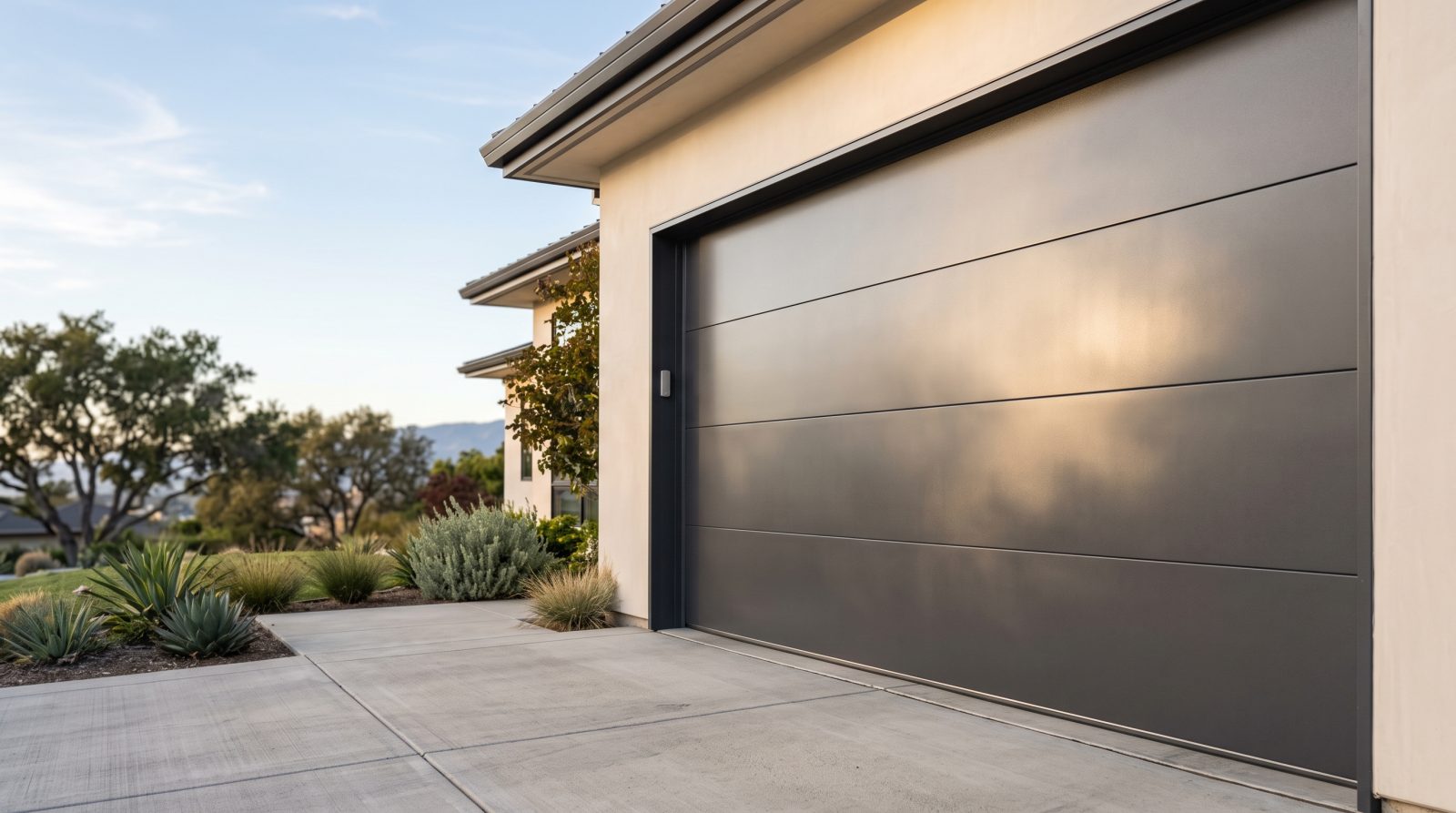
Why Steel Is the Default Choice in the Sacramento Valley
Steel earns its popularity in the Sacramento area because it handles our specific climate well. Inland Valley homes don't fight the salt-air corrosion that coastal Bay Area doors deal with, so a properly finished steel door can last a long time here without rust streaks. What it does have to handle is heat: summer afternoons routinely push past 100 degrees, the south- and west-facing garage doors all over Sacramento, Citrus Heights, and Folsom soak up direct sun, and the surface temperature of a dark door can climb far higher than the air around it. Modern steel doors are built with baked-on, multi-coat finishes designed to resist fading and chalking under that kind of UV load.
Steel is also dimensionally stable. Unlike wood, it won't swell, warp, or split as the humidity drops through a dry Valley summer and creeps back up during winter rain and tule fog. That stability matters for a door that cycles open and closed thousands of times a year, because a panel that stays true keeps the rollers, hinges, and opener tracking the way they should. For most Sacramento homeowners, that translates into fewer service calls and a door that keeps sealing tightly against weather and dust.
Finally, steel gives you the widest range of looks for the money. You can get flush contemporary panels for a modern Midtown remodel, raised short-panel styles that suit the tract homes in Antelope and Rancho Cordova, or steel doors with composite overlays and decorative hardware that mimic carriage-house wood without the upkeep. That flexibility is a big part of why steel is such a common choice across the region.
- Handles 100-degree-plus Valley summers and sharp day-to-night temperature swings
- No coastal salt air inland, so corrosion is far less of a concern than in the Bay Area
- Dimensionally stable: won't warp, swell, or split like wood as humidity changes
- Baked-on, multi-coat finishes resist fading on sun-baked south- and west-facing doors
- Available in flush modern, raised-panel, and carriage-house looks to match any Sacramento neighborhood
Steel Gauge and Construction: What Durability Actually Means
Not all steel doors are built the same, and the differences are easy to miss on a showroom floor. The two specs that drive real-world toughness are the steel gauge and the number of layers in the panel. Gauge is the thickness of the steel skin, and it works in reverse: a lower number means thicker, stronger steel. Many builder-grade and entry doors use lighter 27- to 25-gauge skins, while heavier-duty doors step up to 24-gauge. Thicker steel resists the dents and dings that come with basketballs, car doors, and lawn equipment, which is worth thinking about if your garage doubles as the busiest entrance to the house.
Construction layers are the other half of the story. A single-layer door is one sheet of steel with no backing, which is the lightest and least expensive option and is best for a detached garage or a budget rental. A two-layer door adds insulation bonded to the back of the steel. A three-layer, or sandwich, door encloses that insulation between an outer steel skin and an inner steel or composite backer, creating a rigid, quiet, much stronger panel. For an attached Sacramento garage, especially one used as a gym, office, or workshop, the three-layer steel door is the upgrade most homeowners find worthwhile.
There are a few other build details worth asking about during your in-driveway consultation. Look at the section joints and how the panels meet, the quality of the weatherstripping and bottom seal that keeps Valley dust and summer heat out, and the gauge and finish of the hinges and hardware, since cheap hardware is often the first thing to fail. When we measure your opening, we'll point out which of these matter most for your particular door size and how often it gets used.
- Gauge runs in reverse: lower number = thicker, stronger steel (24-gauge is heavier than 25 or 27)
- Single-layer: lightest and cheapest, best for detached or budget garages
- Two-layer: steel plus bonded insulation for better temperature control and quiet
- Three-layer (sandwich): steel-insulation-steel for maximum strength, rigidity, and noise reduction
- Don't overlook bottom seals, weatherstripping, and hardware gauge, which drive long-term reliability
Insulation and R-Value: Taming the Valley Heat
Insulation is where a steel door really pays you back in Sacramento. An attached garage shares a wall, and often a bedroom, with your conditioned living space, and an uninsulated door turns the garage into a heat trap that bleeds into the house during a long summer. Insulated steel doors use either polystyrene board or, for higher performance, injected polyurethane foam, which expands to fill the panel and also bonds the layers together for a stiffer, quieter door.
The performance number to ask about is the R-value, which measures resistance to heat flow; higher is better. Single-layer steel doors offer essentially no insulation. Two-layer polystyrene doors typically land in a low-to-mid R-value range, while three-layer polyurethane doors reach the highest R-values available in residential steel. For a garage you actually spend time in, or one with living space directly above or beside it, the jump to a foam-insulated door noticeably steadies the temperature and is a sensible choice for attached garages in this climate. Keep in mind that R-value is only one piece of comfort: a good perimeter and bottom seal, plus garage ceiling and wall insulation, all work together.
Insulation also helps in the other direction during our short but real winter cold snaps and foggy mornings, and it cuts down on road and weather noise, which is a quiet bonus on busier streets. If you've converted the garage into a workout room, a home office, or a teen hangout, a well-insulated steel door makes a noticeable difference in comfort and sound. There can also be energy and code considerations for conditioned spaces under California's Title 24 energy standards, which is worth raising if your garage is heated or cooled.
- Polystyrene (board) costs less; polyurethane (injected foam) delivers higher R-value and a stiffer door
- Higher R-value means better resistance to heat flow, which matters most on attached and west-facing garages
- Foam-insulated three-layer doors are a strong choice for garages used as living, work, or gym space
- Insulation also dampens road and weather noise and helps during winter cold snaps and fog
- Pair the door with good seals and garage insulation; Title 24 may apply to conditioned garage spaces
Steel Garage Door Cost: Honest Ranges for Sacramento Homeowners
Pricing a steel garage door comes down to size, construction, insulation, finish, and the condition of your existing opening and hardware. The figures below are general industry cost ranges to help you plan, not a quote; the only way to get an accurate number is to measure your specific opening and see what's behind the door. As a mobile company, we bring that estimate to you at no charge.
As a planning guide, a basic single-layer, single-car steel door installed typically falls in a lower industry range, while an insulated two-layer single-car door sits a step above that. Upgrading to a premium three-layer, foam-insulated steel door, or moving to a double-car (16-foot) door, raises the range further, and adding windows, decorative carriage-style overlays, custom colors, or upgraded hardware pushes it higher still. The price spread between a bare-bones door and a fully insulated, design-forward one is significant, which is exactly why it's worth deciding up front how you use the garage.
A few Sacramento-specific factors can affect the final number. If your old door's springs, tracks, or rollers are worn or mismatched to a heavier insulated door, those may need replacing so the new door operates safely. Larger triple-bay garages common in newer Elk Grove and Roseville builds cost more simply because there's more door. And if you're also looking at a new opener to match a heavier, quieter door, that's a separate line item. We'll lay all of this out transparently before any work begins so there are no surprises.
- Cost drivers: door size, layers/insulation, gauge, finish, windows, and the state of your existing hardware
- Single-layer single-car doors sit at the low end of industry ranges; insulated doors step up from there
- Three-layer foam-insulated and double- or triple-car doors occupy the higher ranges
- Heavier insulated doors may require upgraded springs and rollers to operate safely
- All figures here are industry ranges for planning; we bring a free, measured estimate to your driveway
Choosing and Maintaining a Steel Door That Lasts
The right steel door depends on how you actually live with your garage. For a detached garage or a budget-minded rental, a clean single- or two-layer door does the job. For the typical attached Sacramento home, a two-layer insulated door is a solid baseline, and for any garage that's used as real living or working space, a three-layer foam door is usually the better investment. Color and style matter too: lighter finishes stay cooler in direct sun, and you'll want the panel design to fit the era of your home, whether that's a classic East Sacramento street or a contemporary infill build.
Maintenance on steel is refreshingly light. A wash a couple of times a year keeps the finish clean of Valley dust and pollen, and it's a good moment to check the bottom seal and weatherstripping, since those degrade faster than the steel itself under UV. Lubricating the rollers, hinges, and springs once or twice a year keeps the door quiet and reduces strain on the opener. If you ever notice the door getting louder, moving unevenly, or struggling to lift, those are early signs to have the springs and balance checked before a small issue becomes a stuck door.
Because we're mobile, the whole process happens at your home on your schedule. We measure the opening, confirm headroom and side clearance, review your color and insulation options against how you use the space, and handle the removal and installation in your driveway. If you're not sure whether to repair your current steel door or replace it, we'll give you a straight assessment of what's worth keeping. When you're ready, you can call or request a free quote and we'll come to you anywhere in the Sacramento area.
- Match the build to use: single/two-layer for detached or budget, three-layer foam for lived-in garages
- Lighter finishes run cooler under direct Sacramento sun
- Wash a couple of times a year and inspect seals, which wear faster than the steel under UV
- Lubricate rollers, hinges, and springs once or twice a year to keep the door quiet and easy on the opener
- Louder operation, uneven movement, or hard lifting are early signals to have the balance and springs checked