What R-Value Actually Means on a Garage Door
R-value measures how well a material resists heat flow: the higher the number, the slower heat moves through it. On garage doors you'll see ratings advertised anywhere from R-6 on a basic insulated steel door to R-18 or higher on premium polyurethane models. But the number on the box is only part of the story, and it pays to read it critically before you spend.
There are two ways manufacturers report it. 'Computed' or 'center-of-section' R-value measures only the insulated middle of a panel, ignoring the seams, frame, and air gaps. 'Whole-door' or system R-value accounts for the entire assembly and is always lower, often dramatically so. A door marketed at R-16 center-of-section might perform closer to R-10 or R-12 as an installed system. When we quote insulated doors in Sacramento, we explain which number you're looking at so you can compare brands honestly instead of chasing a spec that doesn't reflect real performance.
The other half of the equation is air sealing. A high R-value panel with worn weatherstripping, a gapped bottom seal, or no jamb seals will leak conditioned air around the edges and undercut the insulation you paid for. As a practical rule, a mid-tier insulated door that is sealed well often outperforms a higher-rated door installed loose.
- R-6 to R-9: entry-level insulated steel, good for a detached garage you rarely occupy
- R-10 to R-13: solid all-around choice for most attached Sacramento garages
- R-16 to R-18+: premium polyurethane for living space, ADUs, workshops, and west-facing exposures
- Always ask whether a quoted R-value is center-of-section or whole-door system
- Insulation only delivers when paired with intact bottom, side, and top seals
Polystyrene vs. Polyurethane: The Choice That Matters Most
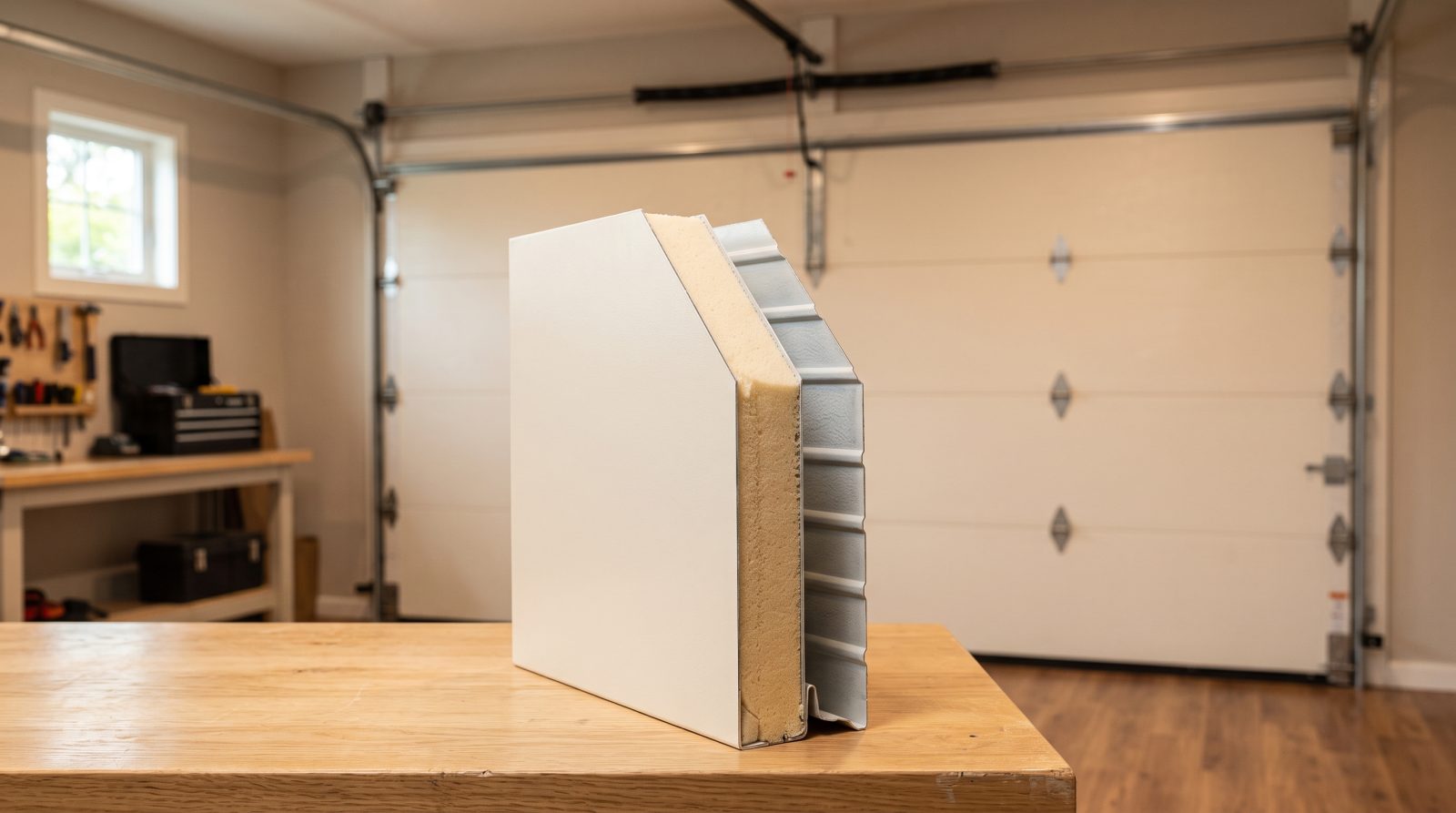
Insulated garage doors come in two main constructions, and the difference is bigger than the price gap suggests. Polystyrene insulation is a rigid foam board cut to fit inside the door panel. It's the more affordable option, adds meaningful R-value over a single-layer door, and helps with both temperature and some noise. For a detached garage or a tight budget, a polystyrene door is a reasonable, durable upgrade.
Polyurethane insulation is foamed-in-place: liquid foam is injected between the steel skins and expands to fill every void, bonding to the panel. This produces a higher R-value per inch, a noticeably more rigid and quieter door, and better long-term resistance to dents and sagging. In Sacramento's heat, polyurethane's tighter, gap-free fill is the construction that holds an attached garage closest to a livable temperature.
Which one is right depends on the room behind the door, your sun exposure, and how long you plan to stay in the home. We'll show you both in the context of your specific opening rather than pushing the most expensive option. If your garage is a detached storage space in the shade, polystyrene may be all you need. If it's an attached garage under a bedroom on a west-facing elevation in Natomas or Elk Grove, polyurethane usually earns its cost.
- Polystyrene: rigid foam board, lower cost, good R-value bump, solid for detached garages
- Polyurethane: foamed-in-place, higher R-value per inch, stiffer, quieter, dent-resistant
- Polyurethane fills gaps completely, which matters most in extreme summer heat
- Door layers also matter: 3-layer (steel-foam-steel) sandwich construction is the quietest and most durable
- Match the construction to the room behind it and your sun exposure, not just the sticker price
Why Insulation Pays Off in the Sacramento Climate
Sacramento's climate is a textbook case for an insulated garage door. Our long, dry summers routinely push afternoon highs past 95 degrees, and an uninsulated steel door turns into a radiant heater, dumping that heat straight into the garage and any room that shares a wall or ceiling with it. The Delta breeze cools things down at night, but a single-layer door barely holds that cool air through the next morning. Insulation flattens those swings so the space starts each day closer to comfortable.
The payoff shows up in three places. First, comfort: an insulated garage commonly runs noticeably cooler in summer and warmer on those few frosty Valley winter mornings, which matters if you've turned the space into a gym, workshop, office, or ADU. Second, energy: if the garage is conditioned or shares an envelope with the house, less heat soaking in means your AC or mini-split cycles less and works less hard during peak SMUD rate hours. Third, protection: paints, adhesives, batteries, electronics, and stored goods all last longer when they aren't cooking at 110-plus degrees inside a sealed metal box.
We won't promise a specific dollar figure on your utility bill, because real savings depend on your insulation, how the garage connects to the house, and how you use it. What we can say honestly is that in our climate, slowing heat transfer through the single largest opening in the wall is one of the highest-impact comfort upgrades available, and it's one we can complete at your home in a single visit.
- Cuts the radiant heat an uninsulated steel door pours into the garage on 95-105 degree afternoons
- Holds the overnight Delta-breeze cool longer into the next day
- Eases load on AC and mini-splits during expensive peak-rate hours
- Protects heat-sensitive stored items: paint, batteries, electronics, adhesives
- Biggest comfort gain for attached garages and converted gyms, offices, or ADUs
Comfort, Noise & Durability Beyond Energy
Energy is the headline, but the everyday comfort and quiet are often what stand out first. A 3-layer insulated door is substantially stiffer than a thin single-layer panel, so it rattles less in the wind, opens and closes with a more solid, dampened sound, and transmits far less street and operator noise into the house. If a bedroom or home office sits above or beside the garage, that quieter operation is a real quality-of-life upgrade, especially on early-morning departures.
That added rigidity also pays off in durability. Foam-filled and sandwich-construction doors resist denting from a stray basketball, ladder, or bumper far better than hollow panels, and they're less prone to the bowing and warping that thin doors can develop after years of intense Sacramento sun on the exterior face. A stiffer door also tracks more smoothly, which can ease wear on rollers, hinges, and the opener over time.
Insulated doors do weigh more, so the opener and springs have to be sized and balanced correctly. This is exactly the kind of detail we check on site: when we install or upgrade to an insulated door, we confirm the door is properly balanced and that your existing opener and spring system are matched to the new weight, so you get the comfort benefits without straining the hardware.
- Quieter operation, valuable when living space sits next to or above the garage
- Stiffer panels resist dents, bowing, and sun-driven warping
- Smoother travel can reduce wear on rollers, hinges, and the opener
- Heavier doors require correctly sized springs and a properly balanced system
- We verify balance and opener/spring match as part of any insulated-door work
How Our Mobile Service Handles Your Insulated Door
We're a fully mobile garage door company, which means there's no showroom to visit and no need to take measurements yourself. We come to your home anywhere in the Sacramento area, look at the actual opening, check the room behind the door, note your sun exposure and how the garage connects to your living space, and walk you through insulated options that fit your situation and budget. Seeing the door in context is the only way to recommend the right R-value and construction honestly.
On the visit we measure precisely, inspect the existing weatherstripping and seals, and assess the springs and opener so the new insulated door is balanced and safe. We can advise on color and panel style to match your home, the difference between adding insulation kits to certain existing doors versus replacing with a purpose-built insulated unit, and what each path realistically delivers. Costs for insulated garage doors vary widely by size, construction, R-value, and window or hardware options, so we provide a clear, itemized quote based on what we see rather than a one-size-fits-all number.
If you're weighing an insulated upgrade, the simplest next step is to request a free quote. We'll give you straight answers about what level of insulation makes sense for your home, schedule same-day or fast service where availability allows, and complete the work at your property. Call or request your free quote and we'll bring the expertise to your driveway.
- No showroom needed: we assess your real opening, room use, and sun exposure on site
- Precise measuring plus inspection of seals, springs, and opener
- Honest guidance on insulation kits vs. replacing with a purpose-built insulated door
- Itemized quote based on your size, construction, R-value, and options, not a flat figure
- Same-day or fast scheduling where available, completed at your home