Why Garage Door Seals Fail Faster in the Sacramento Climate
Garage door seals are consumable parts — they wear out everywhere — but the Sacramento Valley climate is unusually hard on them. Our region swings from long stretches of dry triple-digit heat in summer to damp, foggy winters, and that combination attacks rubber and vinyl from two directions. Heat and UV exposure dry out the bottom astragal and the perimeter stripping, causing the material to lose its flex, harden, crack, and shrink. A bottom seal that was soft and pliable when installed can turn stiff and split after a few brutal summers, especially on doors that face west or south and take the worst of the afternoon sun.
Winter does its own damage. When the Delta breeze dies down and Tule fog settles in, garages hold cool, damp air, and any seal that's already shrunk or cracked lets moisture creep under the door and along the slab. Sacramento-area homes also deal with a lot of fine dust and seasonal pollen, which works into worn seals and accelerates abrasion every time the door cycles. Add the region's clay-heavy soils, which expand and contract with the wet and dry seasons and can subtly shift a slab or threshold over time, and you have a recipe for seals that fail sooner than the manufacturer's optimistic estimate.
The practical takeaway: in this climate, treat garage door weatherstripping as a maintenance item you inspect roughly once a year, not a part you install once and forget. Catching a hardening seal before it splits keeps heat, water, and pests out — and protects whatever you store in the garage from the same temperature extremes that ruined the seal in the first place.
The Main Types of Garage Door Seals (And Where Each One Goes)
"Weatherstripping" is really a system of several different seals, each protecting a different edge of the door. Knowing which is which makes it far easier to diagnose where your air or water is getting in and to order the correct replacement. Using the wrong profile is the single most common DIY mistake — a seal that doesn't match the door's retainer or material simply won't seal, no matter how new it is.
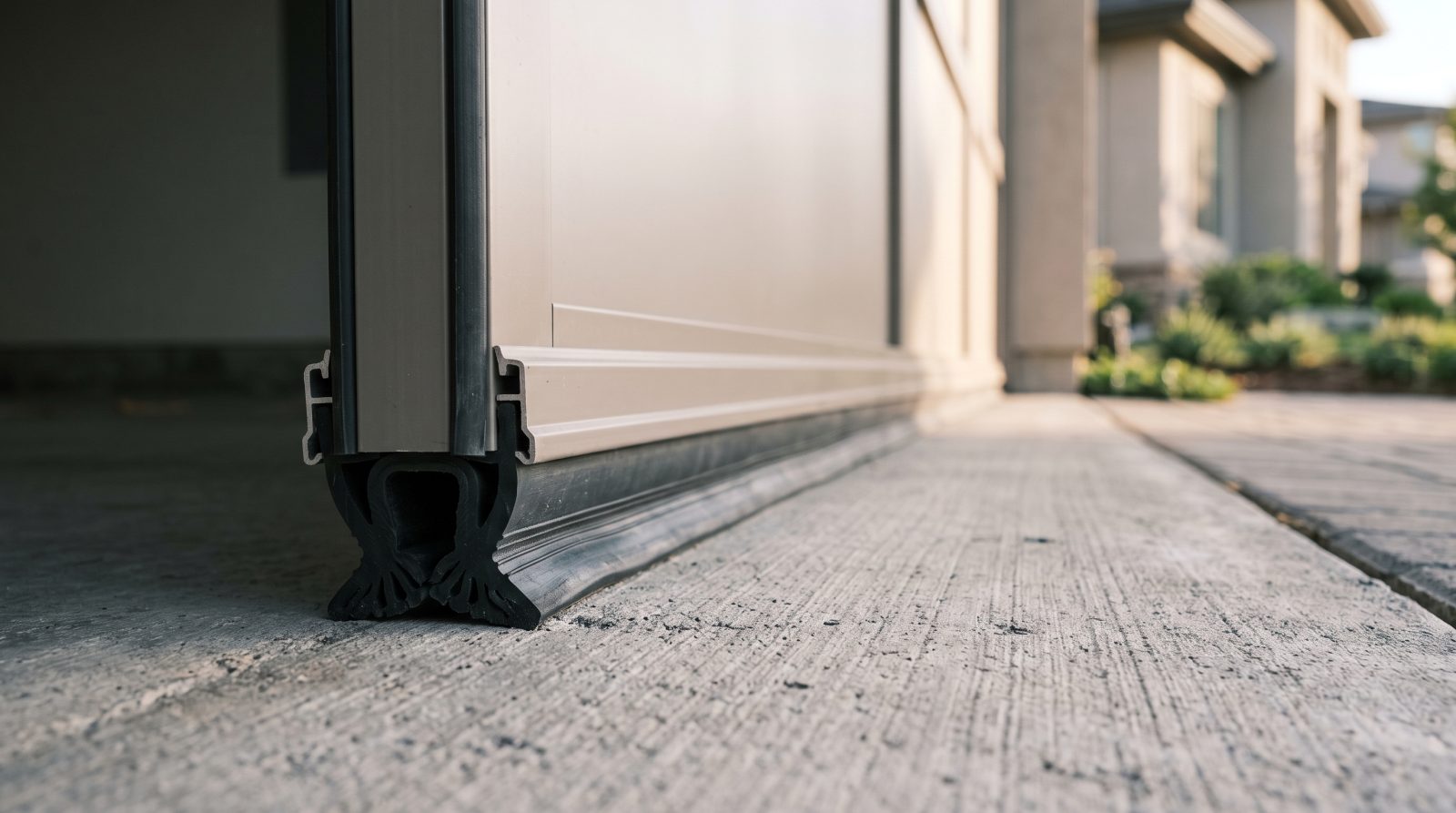
- Bottom seal (astragal): The long rubber or vinyl strip along the bottom edge of the door that compresses against the floor. Most sectional doors use a profile (T-style, P-bulb, or beaded) that slides into an aluminum retainer track on the bottom panel. This is the seal that wears fastest and matters most for keeping out water, dust, and small pests.
- Bottom retainer / threshold seal: On uneven or settled concrete — common with older Sacramento-area slabs — a floor-mounted threshold seal can be bonded to the driveway to meet the door's bottom seal, closing gaps that the door seal alone can't bridge.
- Perimeter / jamb weatherstripping: The flexible strip (often vinyl with a flange, nailed or stapled to the wood door stop) running up both sides and across the top of the door opening. It seals the gap between the door face and the frame.
- Top seal: Sometimes integrated with the perimeter stripping, sometimes a separate piece, it closes the gap above the top panel when the door is down.
- Between-panel seals: On insulated sectional doors, thin seals or shaped joints between horizontal panels reduce air leakage and pinch points. These are usually built into the panels rather than replaced separately.
- Brush seals: A bristle-style seal used on some doors (and side man-doors) where a flexible brush handles uneven gaps and resists dust intrusion.
Signs Your Bottom Seal or Weatherstripping Needs Replacing
Most seal failures announce themselves well before they become a real problem, if you know what to look for. The fastest check is the simplest one: with the door fully closed, step into the garage in the middle of a bright Sacramento afternoon and look along the bottom and edges. Daylight peeking through means a sealing gap, and where light gets in, so do heat, dust, water, and insects.
Beyond the daylight test, pay attention to how the garage feels and behaves through the seasons. A garage that's suddenly much hotter in summer or that smells damp or musty after a winter rain is often telling you the seals have given up. Water staining or a thin line of grit just inside the door after a storm is a classic sign the bottom seal has flattened or cracked. And if you're seeing more spiders, ants, or even evidence of rodents, a gap under the door is the usual entry point.
- Visible daylight under or around the door when it's fully closed
- Cracked, split, hardened, or flattened bottom rubber that no longer springs back
- Water, leaves, or dust blowing or seeping in along the bottom after rain or wind
- A noticeable jump in garage temperature, or rooms above/beside the garage feeling drafty
- Musty, damp smell after winter fog or rain
- More insects or signs of rodents getting in at floor level
- Perimeter stripping that's brittle, peeling away from the frame, or missing chunks
- Gaps at the corners where the bottom seal meets the vertical tracks
What a Proper Seal Replacement Involves
Replacing a bottom seal sounds trivial, but doing it right is mostly about matching parts and prepping surfaces — and that's where a lot of DIY attempts go sideways. The first step is identifying the existing retainer and seal profile. Older doors may have a single-channel aluminum retainer, while newer doors often use a double-channel design, and the replacement astragal has to match the channel shape and width exactly. The right move is to remove a short section of the old seal and bring the profile (or a clear photo and measurement) when sourcing the replacement, then buy the full width of the door plus a little extra.
Installation itself means cleaning years of grit out of the retainer track, often lubricating the channel so the new seal slides in without tearing, threading the new astragal through from one end, and trimming it flush. On the perimeter, old vinyl stripping is pried off the wood stop and replaced with new flanged stripping, positioned so it just kisses the closed door — too tight and the door binds, too loose and it doesn't seal. On uneven slabs, which are common around the region's older neighborhoods and homes on expansive clay, a separate threshold seal bonded to the concrete may be the only way to close a stubborn gap.
Because we're a mobile garage door company, this is a service we bring to your driveway — there's no storefront to visit and no hauling the door anywhere. A technician can assess the door, confirm the correct seal profiles on the spot, and handle the prep, fit, and trimming so the new seal actually seals and the door still operates smoothly. If you'd rather have it done right the first time without sourcing parts and matching profiles yourself, you can request a free quote and we'll come to you anywhere in the Sacramento area.
Seal Replacement Cost Ranges in the Sacramento Area
Costs vary with the door size, the seal types involved, and the condition of the slab and frame, so treat the following as general industry ranges rather than a quote for your specific door. A new bottom seal (astragal) is an inexpensive part on its own; the variable is labor and whether the retainer also needs cleaning, repair, or replacement. Perimeter weatherstripping for the sides and top is likewise a modest material cost, with the labor depending on how much old, brittle stripping has to come off and how straight the wood stop still is.
The bigger cost driver is the slab. If your driveway has settled or heaved — something Sacramento's clay soils and decades of seasonal moisture make fairly common — a simple bottom seal may not be enough, and a bonded threshold seal adds material and prep time. Double-car doors, taller doors, and insulated doors with between-panel sealing also push the range up because there's simply more linear footage and more parts to fit. For a realistic picture, here are the typical ranges you'll see in the market for these jobs.
- Bottom seal (astragal) replacement, standard single door: a low materials cost plus a modest service charge — generally the most affordable seal job
- Perimeter / jamb weatherstripping for sides and top: a low-to-moderate range depending on door size and how much old stripping must be removed
- Threshold seal bonded to the slab (for uneven concrete): a moderate add-on due to extra material and prep
- Full reseal of a double-car or oversized door: a higher range reflecting more linear footage and multiple seal types
- Note: figures above are general industry ranges, not a quote — actual pricing depends on your door, seals, and slab condition once a technician sees it