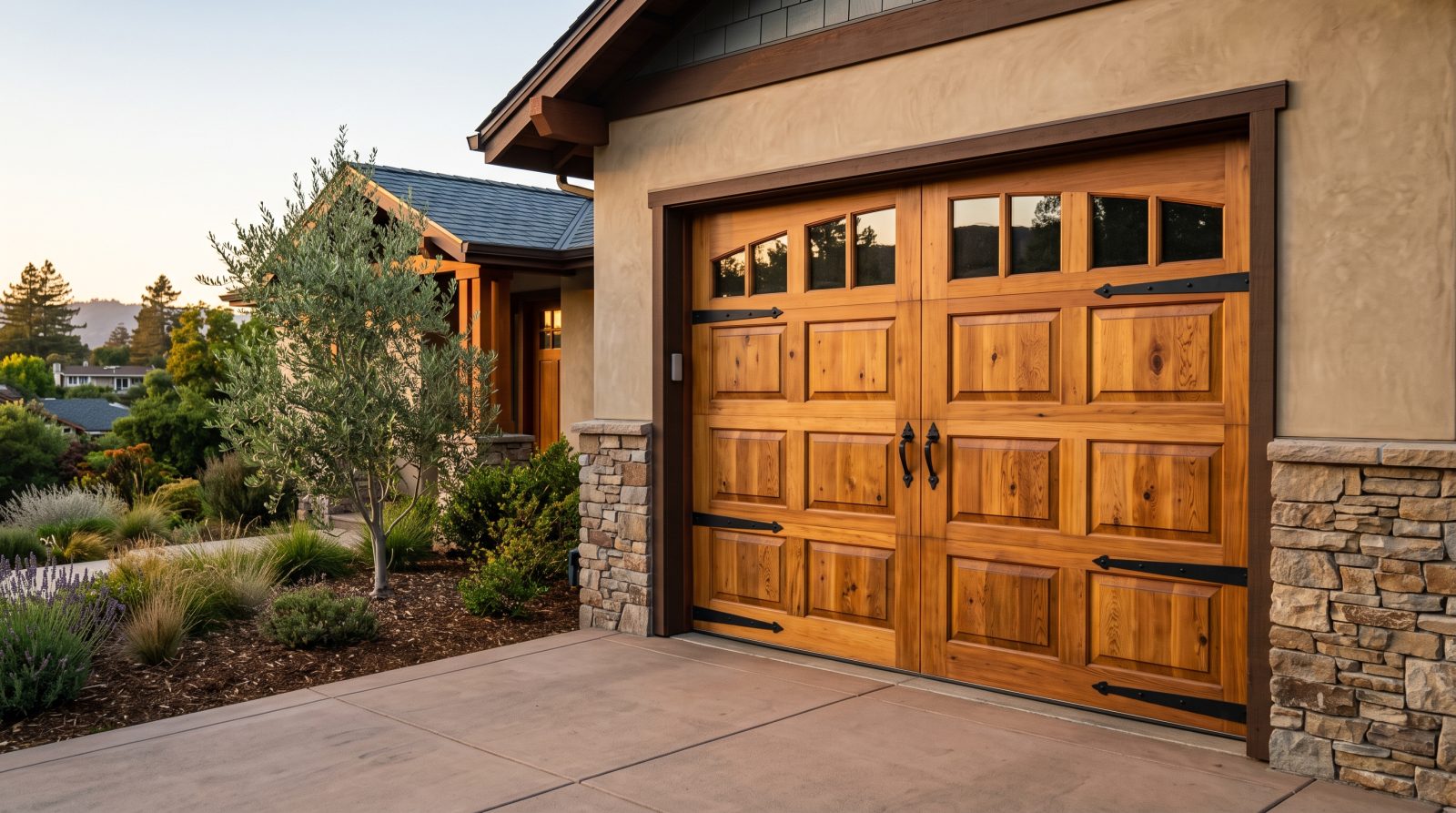
Why a real wood garage door still wins on curb appeal
A garage door is often the single largest design element on a Sacramento facade, frequently 30 to 40 percent of what you see from the street. That scale is exactly why genuine wood reads so differently from steel or composite. Real wood has grain depth, tonal variation, and a way of catching light that printed wood-grain finishes can imitate but never fully match. On the period homes of East Sacramento, Land Park, and Curtis Park, a custom wood door reinforces the architecture instead of fighting it, and on modern builds in Folsom, El Dorado Hills, and Granite Bay, clean horizontal wood slats deliver that warm, high-end contemporary look designers keep reaching for.
Wood is also the most customizable door material available. Because each door is essentially built rather than stamped, you have real freedom over panel layout, stile-and-rail proportions, window placement, hardware, and stain tone. That flexibility is what lets a door feel like it was designed for your specific house rather than pulled off a shelf. For homeowners restoring an older Sacramento property, wood is often the only way to honestly match the era and detailing of the original architecture.
There is a resale dimension too. In established, design-conscious neighborhoods, a well-kept custom wood door can meaningfully lift perceived value and how quickly a home reads as cared-for. The honest tradeoff is upkeep: wood rewards attention and punishes neglect, especially in our climate. The rest of this page is about going in with eyes open so the beauty lasts.
- Genuine grain depth and light play that printed finishes can't fully replicate
- Fully customizable panel layout, proportions, windows, and hardware
- The most authentic match for Tudor, craftsman, and period Sacramento homes
- Strong curb-appeal and resale impact in design-conscious neighborhoods
Best wood species for Sacramento's climate
Not every wood handles the Sacramento Valley equally well. Our summers routinely push past 95 to 100-plus degrees with intense, direct sun, then humidity drops sharply, conditions that make woods expand, contract, and dry out. The species you choose largely determines how much fighting you'll do with the climate over the door's life.
Cedar is the most popular real-wood choice here for good reason: it's naturally resistant to rot and insects, relatively stable through heat-and-dry cycles, and lighter weight, which is easier on springs and openers. Redwood, a California classic, offers similar rot resistance with a rich, warm tone that suits Valley homes beautifully, though sourcing and cost have shifted over the years. Mahogany and other hardwoods deliver a denser, more luxurious look and excellent durability, but they're heavier and command a premium. Engineered or veneered wood doors, a real wood skin over a stable core, are worth a serious look in full-sun exposures because the core resists the warping that solid panels are prone to in extreme heat.
Orientation matters as much as species. A west- or south-facing door in Roseville, Elk Grove, or Folsom takes punishing afternoon sun and will fade and dry faster than a shaded north-facing door in a tree-lined East Sacramento block. We factor your exposure into both the species recommendation and the finish plan when we come out to look at the actual installation.
- Cedar: rot- and insect-resistant, stable in heat, lighter on hardware
- Redwood: classic California warmth with natural rot resistance
- Mahogany/hardwoods: luxurious and durable, but heavier and pricier
- Engineered/veneered cores: best bet for harsh, full-sun west exposures
- Door orientation drives how fast any wood fades and dries here
The real maintenance reality (and how to make it manageable)
This is where honesty serves you best. A wood garage door in Sacramento is not a set-and-forget product. UV exposure breaks down finishes, the dry season pulls moisture out of the wood, and winter rain and Delta fog push it back in, so the surface is constantly working. The finish is your entire line of defense, and on a sun-exposed door it simply doesn't last as long as it would in a milder coastal climate.
As a general rule, expect to refresh a stain or sealer on a sun-facing Sacramento door more often than the manufacturer's best-case schedule suggests, and to keep a closer eye on it than you would on the same door in, say, the Bay fog belt. The visual warning signs are easy to read once you know them: dulling or chalky finish, color fading on the most exposed panels, hairline cracks in the finish, and water that stops beading and starts soaking in. Catching those early, before bare wood is exposed, is the difference between a quick re-coat and a full strip-and-refinish.
The good news is that a manageable routine keeps wood beautiful for the long haul. Gentle cleaning a couple of times a year, prompt attention to any chips or scratches, periodic re-sealing on the schedule your specific exposure dictates, and keeping sprinklers from spraying the lower panels go a long way. We can assess your door's current condition on-site and give you a finish-refresh interval based on your actual exposure rather than a generic number.
- UV and the wet-dry seasonal swing make the finish wear faster on sun-facing doors
- Watch for: chalky/dull finish, fading, hairline finish cracks, water that no longer beads
- Re-coat before bare wood shows to avoid a full strip-and-refinish
- Keep sprinklers off the bottom panels and clean gently twice a year
- Refinish interval depends on YOUR exposure, not a one-size number
Solid wood vs. wood-look alternatives
Many Sacramento homeowners love the look of wood but want to know what they're signing up for before committing. There's no single right answer, only the right answer for your priorities, budget, and how much upkeep you'll realistically do.
Solid wood gives you the most authentic appearance and the deepest customization, and it can be repaired, sanded, and refinished essentially indefinitely if you stay on top of it. The tradeoff is the maintenance and the higher upfront cost, plus more sensitivity to our extreme sun. Wood-look alternatives, faux-wood steel or composite doors and fiberglass with wood-grain texturing, have come a long way and now look convincing from the curb. They shrug off UV and moisture, need almost no upkeep, and cost less, but up close and over time they don't carry the same depth and they can't be refinished into a brand-new look the way real wood can.
A practical middle path many homeowners choose is the engineered or wood-overlay door: a stable, low-warp core with a genuine wood face, or a carriage-style steel door with a real wood overlay. You get much of the authentic look with better dimensional stability in our heat. When we come out, we'll walk through these honestly against your house, your exposure, and how hands-on you want to be, no pressure toward the most expensive option.
- Solid wood: most authentic and endlessly refinishable, but highest upkeep and cost
- Faux-wood steel/composite/fiberglass: low-maintenance and UV-tough, less depth up close
- Engineered core + real wood face: a stable, lower-warp compromise for our heat
- The right pick depends on budget, exposure, and your appetite for maintenance
Repair, refinishing, and care for the wood door you already own
If you already have a wood garage door, you don't have to replace it to bring it back. Many Sacramento doors that look tired are structurally sound and just need refinishing and hardware attention. We handle wood-door service mobile, coming to your home to assess the panels, springs, rollers, hinges, and opener as a system, because a heavy wood door puts real load on its hardware and a worn spring or roller shortens the life of everything else.
Common issues we see in the area: faded and peeling finish from years of afternoon sun, swollen or sticking bottom panels where sprinklers or standing water have gotten in, sagging from undersized or fatigued springs carrying the door's weight, and split or cracked panels that need filling, repair, or section replacement. Because wood is repairable, a lot of these are fixable without a full new door, which is often the more cost-effective path for a quality door that's simply been neglected.
Whether you're considering a new custom wood door, weighing a wood-look alternative, or trying to save and refresh the one you have, the smartest first step is an on-site look at your actual door and exposure. We'll give you a straight assessment and the realistic maintenance picture so you can decide with confidence. Call or request a free quote and we'll come to you.
- Mobile, on-site service: we come to your Sacramento-area home
- We assess the door AND its hardware (springs, rollers, hinges, opener) as a system
- Refinishing and panel repair often beat full replacement on a quality door
- Straight, no-pressure assessment of repair vs. replace vs. wood-look options