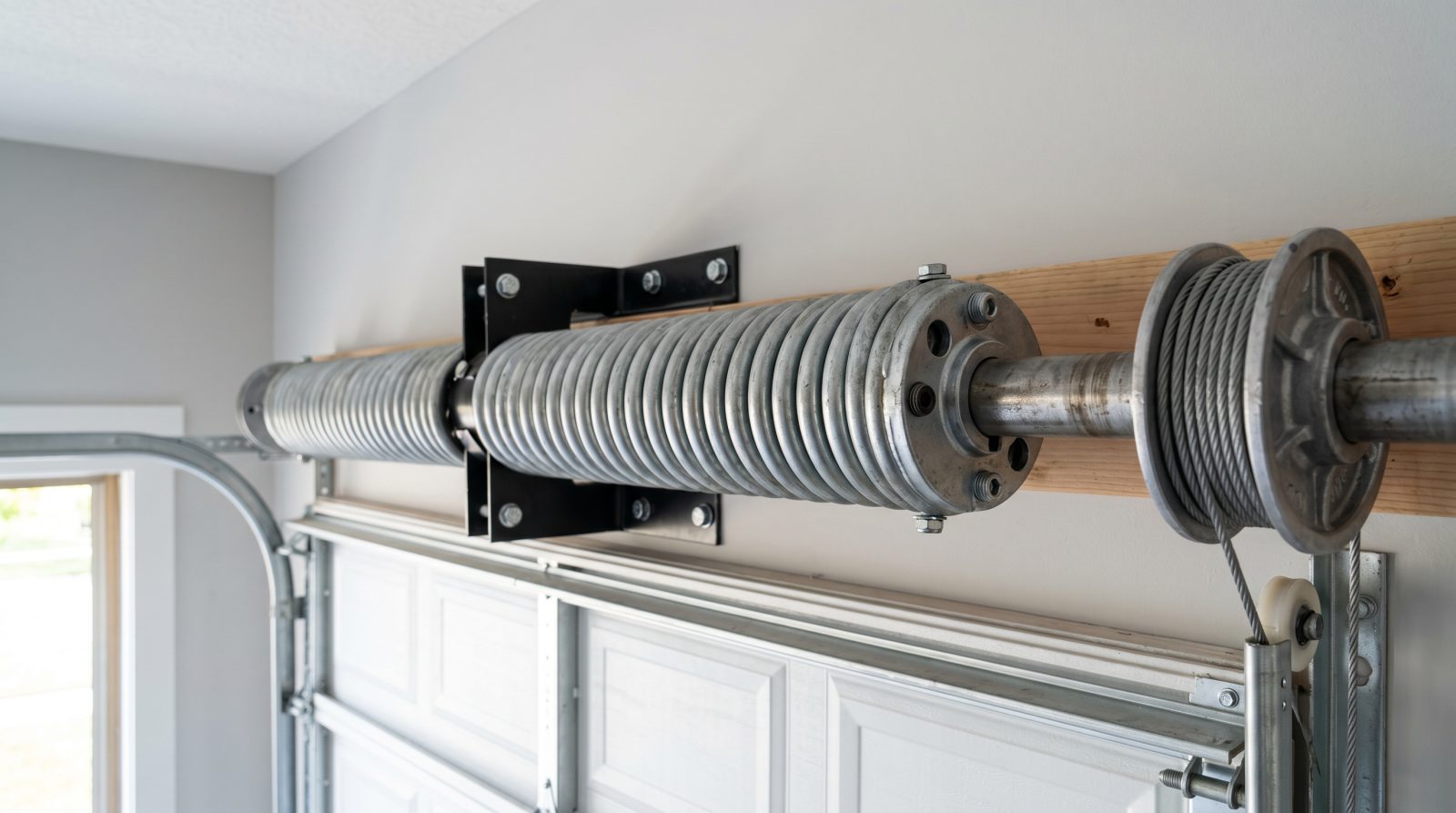
How to Tell If Your Garage Door Spring Is Broken
Most spring failures announce themselves clearly once you know the signs. The spring is the component that counterbalances the entire weight of the door, so when it snaps, the opener and your own arms suddenly have to lift the full load alone. A typical double door panel system can weigh well over a hundred pounds, and once the spring is gone, that weight has nowhere to go but down.
If you are unsure whether the spring is the problem or something else, like a bad opener, a snapped cable, or a door off its track, our mobile techs can diagnose it on-site in your driveway. The fix differs completely depending on the cause, and replacing the wrong part wastes your money. The signs below are the most reliable indicators that a spring, not the opener, is what failed.
- You heard a loud bang or pop from the garage, often while the door was closed and no one was using it.
- A visible gap in the torsion spring above the door, the coil now looks like two separate pieces with a two-inch gap between them.
- The door opens only a few inches with the opener, then stops or reverses because the motor senses too much weight.
- The door feels extremely heavy when you try to lift it by hand, or it slams down fast instead of staying put.
- The opener strains, hums, or struggles, and the safety reverse keeps kicking in even though nothing is blocking the door.
- The door is crooked, with one side higher than the other, which often points to a broken extension spring or cable on that side.
Torsion vs. Extension Springs: Which One Do You Have?
Garage doors use one of two spring systems, and the difference matters because the repair, the parts, and the risks are not the same. Knowing which type you have helps you describe the problem and helps us bring the correct components to your home the first time.
Torsion springs are the most common system on Sacramento homes built or re-doored in the last couple of decades. They sit on a metal shaft mounted horizontally above the door opening and store energy by twisting tightly. When the door moves, the spring winds and unwinds to do the heavy lifting. Because they are under enormous stored tension, torsion springs require winding bars and specific technique to service safely.
Extension springs are the long, stretched springs you see running parallel to the horizontal tracks on either side of the door, more common on older homes and lighter single-car doors around neighborhoods like Tahoe Park, Oak Park, and parts of Carmichael. They stretch and contract as the door moves. A properly installed extension spring system should always include safety cables running through the spring so that if it snaps, the broken piece cannot become a projectile inside the garage.
On both systems, springs are sized to the specific weight and height of your door. A spring that is even slightly mismatched will wear out faster, strain the opener, and make the door dangerous to operate, which is why on-site measurement matters more than grabbing a generic part.
- Torsion system: spring(s) mounted on a shaft above the door; smoother, longer-lasting, and standard on most modern doors.
- Extension system: springs along the side tracks; older and lighter setups, and they should always have safety cables installed.
- Springs are rated by wire size, length, and inside diameter, all matched to your exact door weight, so sizing is not one-size-fits-all.
- If you have two springs and only one broke, replacing both at once is usually the smarter call since the second is likely near the end of its life too.
Why Garage Door Springs Break
Springs do not fail randomly. They wear out on a predictable schedule, and a handful of local and mechanical factors decide whether yours lasts five years or fifteen. Understanding the cause helps you get more life out of the replacement.
The biggest factor is simple cycle count. A garage door spring is typically rated for a set number of cycles, where one cycle is a full open and a full close. A common builder-grade spring is rated somewhere around 10,000 cycles. A household that runs the door four to six times a day will burn through that in roughly four to seven years, while a busy family using the garage as the main entrance, common across Sacramento commuter suburbs, can reach it much sooner. When that count runs out, the metal has fatigued and the spring simply gives way.
Sacramento's climate plays a real role too. Our wide daily temperature swings, hot dry summers in the triple digits followed by cool nights, and damp valley winters cause the metal to expand and contract repeatedly, which accelerates fatigue. Cold mornings in particular are when many springs finally snap, because metal is more brittle at lower temperatures and the first lift of the day puts peak stress on an already tired spring.
Maintenance, or the lack of it, is the other big lever. Springs that are never lubricated develop friction, rust, and uneven wear that shorten their life dramatically. Rust from valley humidity eats into the coils and creates weak points. And neglected hardware, worn rollers, loose cables, or a door that is out of balance, forces the spring to work harder than it should on every single cycle.
- Normal wear: every spring has a finite cycle life, and heavy daily use reaches it faster.
- Temperature swings: Sacramento's hot days, cool nights, and cold winter mornings fatigue the metal and trigger many breaks.
- Rust and lack of lubrication: dry, corroded coils wear unevenly and fail early; light periodic lubrication extends life.
- Improper sizing: an undersized or mismatched spring is overworked from day one.
- An unbalanced door: bad rollers, cables, or tracks make the spring carry more than its share of the load.
Why Spring Repair Is a Job for a Pro (The Safety Reality)
This is the section we most want you to read. A garage door spring stores a tremendous amount of energy under tension, and that energy does not disappear when the spring breaks, it stays bound up in the system. Torsion springs in particular are wound tight enough that a slip while adjusting them can cause serious injury to hands, face, or eyes. The winding bars used to service them have to be the correct size and fully seated, and the technique has to be precise. This is genuinely one of the most injury-prone DIY repairs in the home.
Beyond the spring itself, a safe repair means inspecting the whole counterbalance system. A trained tech checks the cables, the drums, the bearings, the shaft, and the door balance, because a spring that broke early is often a symptom of another worn part dragging the system down. Replacing only the spring while ignoring a frayed cable or a seized roller just sets you up for another failure.
Our approach is built around bringing the shop to you. Because we are fully mobile, our techs arrive at your Sacramento-area home with correctly sized springs, professional winding tools, and replacement hardware on the truck, so the repair gets done on-site, often the same day. After installation we re-balance the door, test the opener's safety reverse, and lubricate the moving parts so the new spring starts its life under the best possible conditions.
- Stored tension is dangerous: even a broken spring and its cables can release energy unexpectedly.
- Correct tools and technique matter: proper winding bars and precise winding are not optional for torsion springs.
- Whole-system check: we inspect cables, drums, bearings, and balance, not just the obvious broken part.
- Same-day mobile service: we come to you across the Sacramento area with the right parts on the truck.
- Finish-the-job standard: re-balance the door, test the safety reverse, and lubricate before we leave.
What Garage Door Spring Repair Costs in the Sacramento Area
Spring repair pricing depends on real variables, so be cautious of any number quoted before someone has seen your door. The main drivers are the spring type, how many springs your door needs, the size and weight of the door, and whether related parts like cables or bearings also need replacing. As a rough industry guide only, single torsion spring replacements commonly fall in a lower range, while replacing a pair of springs on a heavier double door, or fully converting an old or undersized setup, sits higher. These are general ranges, not a quote for your specific door.
The most cost-effective decision for most homeowners is to replace springs in pairs when the door uses two. If one has reached the end of its cycle life, the other is usually close behind, and doing both in a single visit means one trip charge and a door that stays balanced. We will always walk you through exactly what your door needs and what it does not before any work begins, so there are no surprises.
Because we are a mobile operation serving the whole region, you get a tech and the parts at your door rather than hauling a heavy spring system anywhere yourself. To get a real number for your exact door, the fastest path is to request a free quote and let us assess it on-site or with a few details about your door.
- Cost drivers: torsion vs. extension, one spring vs. two, door size and weight, and any related worn parts.
- Ranges only: published figures are industry ballparks, never a firm quote until your door is assessed.
- Replace in pairs: doing both springs in one visit saves a second trip and keeps the door balanced.
- No surprises: we explain exactly what your door needs before we start any work.
- Free quote: request one and we will give you a real number for your specific door.