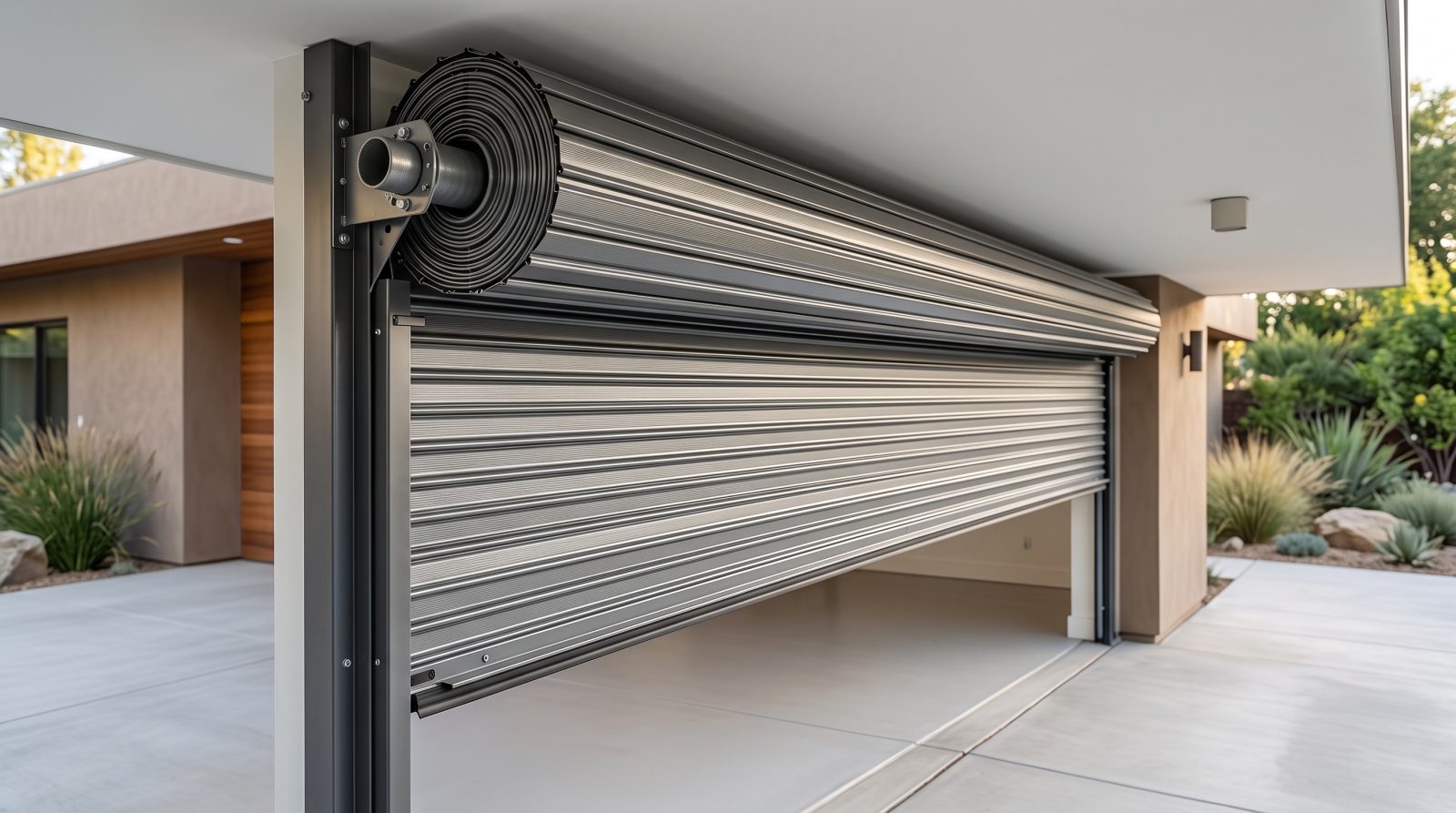
What a Roll-Up (Coiling) Door Actually Is — and How It Differs From a Sectional
The terms get used loosely, so it helps to be precise. A true roll-up or coiling door is built from a continuous curtain of narrow interlocking horizontal slats. When you open it, the curtain coils up around a barrel mounted in a hood above the opening — there are no overhead horizontal tracks running back into the ceiling. A sectional door, by contrast, is made of large hinged panels that bend at the lintel and ride back along the ceiling on tracks. Knowing which one you have changes everything about how it is serviced, what parts it needs, and what it costs to repair.
Because a coiling door rolls into a compact bundle directly above the opening, it needs almost no headroom and no ceiling clearance. That single trait is why it dominates two situations in the Sacramento area: commercial buildings that want maximum ceiling height for storage, racking, or equipment, and compact older homes where the garage ceiling is low, the rafters are exposed, or there is simply no room for tracks to extend backward. If you have ever looked at a tight Midtown alley garage or a vintage detached single-car garage in Curtis Park, you have probably seen why a roll-up is often the only thing that fits.
- Curtain of interlocking slats that coils around an overhead barrel — no back-of-ceiling tracks
- Minimal headroom and side-room required, which preserves usable interior height
- Common on commercial bays, mini-storage, alley garages, and low-clearance home garages
- Two broad grades: light-duty rolling sheet doors and heavier service/security coiling doors
- Serviced very differently from sectional doors — different springs, parts, and failure points
Where Roll-Up Doors Make Sense Across the Sacramento Area
On the commercial side, roll-up and coiling doors are everywhere in the region's working corridors — warehouses and shops around Power Inn Road and Florin-Perkins, the light-industrial pockets of West Sacramento and North Highlands, the redeveloping bays near the Railyards, and the many tenant spaces inside business parks off Highway 50 and I-80. For these buildings, coiling doors deliver security, durability against daily cycling, and the headroom that racking and forklifts demand. Many of these are 'service doors' that get opened and closed dozens of times a day, so spring and bearing wear is a real maintenance reality rather than a theoretical one.
On the residential side, roll-ups solve a specific Sacramento problem: a lot of the region's charm is in its older housing stock, and older houses often have small, low garages that predate modern cars and modern sectional doors. In neighborhoods like Oak Park, Tahoe Park, East Sacramento, and the alley-loaded blocks of Midtown, a compact rolling door can be the difference between a usable garage and a permanently jammed one. Newer compact-lot construction in Natomas, Elk Grove, and parts of Folsom also occasionally uses roll-ups where builders prioritized interior ceiling space.
Because we operate as a mobile service, the building type does not change how we reach you. We come to the commercial bay, the home garage, or the mixed-use property and do the assessment, repair, or install on site. There is no storefront to visit and no second trip to coordinate — a meaningful advantage when your overhead door is the only way product, vehicles, or equipment move in and out.
- Commercial warehouses, shops, and tenant bays in industrial corridors region-wide
- Mini-storage and self-storage facilities that rely on rows of light rolling doors
- Older infill homes with low ceilings or alley-loaded garages where tracks will not fit
- Compact-lot newer builds where interior ceiling height was prioritized
- Mixed-use and live/work properties common in and around Midtown
What Fails on Roll-Up Doors in the Central Valley Climate
Sacramento's climate is hard on coiling doors in ways that are easy to underestimate. Summers regularly push into triple digits, and a metal curtain sitting in direct Central Valley sun expands, contracts, and bakes day after day. That thermal cycling, combined with our long dry, dusty stretches and the grit that blows in before the Delta breeze arrives in the evening, is a recipe for sluggish operation. Dust and fine debris pack into the guide rails and the coil, dried-out lubricant turns to a sticky film, and a door that rolled smoothly in spring starts grinding, hesitating, or binding by mid-summer.
The other common failure is mechanical wear from the coiling mechanism itself. Roll-up doors store their lifting force in a torsion spring assembly inside the barrel, and that spring is under constant tension every cycle. On a high-use commercial door, a fatigued or broken spring is one of the most frequent service calls — and it is genuinely dangerous to work on without the right winding tools and experience. Bent or crimped slats (often from a forklift bump, a vehicle tap, or an attempted forced entry), worn end bearings, misaligned guides, and seized barrels round out the usual list. On older residential roll-ups, decades-old galvanizing can also give way to surface rust along the bottom slats where moisture collects.
The practical takeaway is that roll-up doors reward maintenance and punish neglect. A door that gets its guides cleaned, its curtain and bearings lubricated with the right product, and its spring tension checked tends to last and cycle smoothly through Sacramento summers. A door that gets ignored until it jams usually needs a more involved — and more expensive — repair. Because we are mobile, we can diagnose the actual cause on site rather than guessing, which keeps you from paying to replace parts that were never the problem.
- Heat-driven expansion and contraction from triple-digit Central Valley summers
- Dust and grit packing into guide rails and the coil, gumming up movement
- Dried or wrong lubricant causing grinding, hesitation, and binding
- Worn or broken torsion springs in the barrel — the most common and most hazardous failure
- Bent or crimped slats from forklift, vehicle, or forced-entry impact
- Worn end bearings, misaligned guides, and rust on older bottom slats
Repair, Replacement, and New Installation — What's Involved
The first step on any roll-up job is an honest diagnosis. Many doors that feel 'dead' just need their springs re-tensioned, their guides cleaned and realigned, and proper lubrication — not a full replacement. Others, especially where the curtain is bent across multiple slats or the barrel and bearings are worn out, are genuinely better replaced than repaired. We will tell you which situation you are in and explain the reasoning, rather than defaulting to the most expensive option. For commercial customers, we also factor in cycle count: a door that opens hundreds of times a week is a different maintenance conversation than a home garage opened twice a day.
When repair is the right call, common fixes include replacing or re-winding the torsion spring, swapping worn end bearings, replacing damaged slats (on doors where individual slats can be removed), realigning or replacing guide rails, and re-securing the hood and barrel. When replacement makes more sense, we help you match the door to the use: a heavier-gauge insulated coiling door for a building that needs security and some thermal control, or a lighter rolling sheet door for a budget-sensitive utility opening. For compact homes, we focus on getting the right curtain width, the correct spring rating for the door's weight, and a clean fit into an opening that may not be perfectly square in an older structure.
New installations follow the same on-site, mobile approach. We measure the opening, confirm the available headroom and side-room, check the mounting surface (masonry, wood framing, or steel), and verify that the spring and barrel are sized to the actual door weight — getting that sizing wrong is the single biggest cause of premature failure on a new roll-up. Every job ends with a real test: we cycle the door, confirm it travels smoothly through its full range, check the balance, and make sure any safety reversing features on powered units behave correctly before we consider it done.
- On-site diagnosis first — repair when sensible, replace only when it genuinely makes sense
- Spring re-winding/replacement, bearing swaps, slat replacement, and guide realignment
- Door selection matched to use: insulated security coiling vs. light rolling sheet doors
- Correct spring and barrel sizing to the actual door weight — the key to longevity
- Careful fitting into out-of-square openings common in older Sacramento homes
- Full cycle test, balance check, and safety verification before any job is called complete
Powered Operators, Safety, and Same-Day Mobile Service
Many commercial coiling doors and an increasing number of residential roll-ups run on a powered operator rather than a chain hoist or manual pull. Motorized coiling doors use different operators than sectional doors — typically a heavier-duty unit geared for the curtain's weight and duty cycle — and they have their own safety considerations. On any powered door we service, we check that the door reverses or stops appropriately when something is in its path, that limit settings are correct so the curtain does not over-travel and damage itself, and that manual-release or chain-hoist backup works so you are never locked out during a power interruption — a relevant concern given the region's summer grid strain.
Safety is not an upsell on these doors; it is the core of doing the job right. A heavy coiling curtain under spring tension is one of the more dangerous pieces of equipment on a property, and improper spring work is exactly where do-it-yourself attempts go badly wrong. That is the strongest reason to bring in someone who works on these every day, with the correct winding bars, the right replacement parts, and the experience to balance the door so the operator is not fighting the spring on every cycle.
Because we are mobile and based in the Sacramento area, we can usually get to you the same day for urgent situations — a jammed commercial bay that is holding up your operation, or a home door stuck open and exposing the garage. You do not bring the door to us; we bring the service to the loading dock, the warehouse, or the driveway. When you are ready, you can call or request a free quote, describe the door and the symptoms, and we will come out, diagnose it in person, and give you a clear, no-pressure recommendation.
- Powered coiling operators sized to the curtain's weight and duty cycle
- Safety reversing/stopping checks and correct limit settings on powered doors
- Verified manual or chain-hoist backup so you are not locked out during outages
- Spring and tension work handled with proper tools — not a safe DIY task
- Same-day mobile response for urgent commercial and residential roll-up issues
- We come to your dock, warehouse, or driveway — no storefront visit required