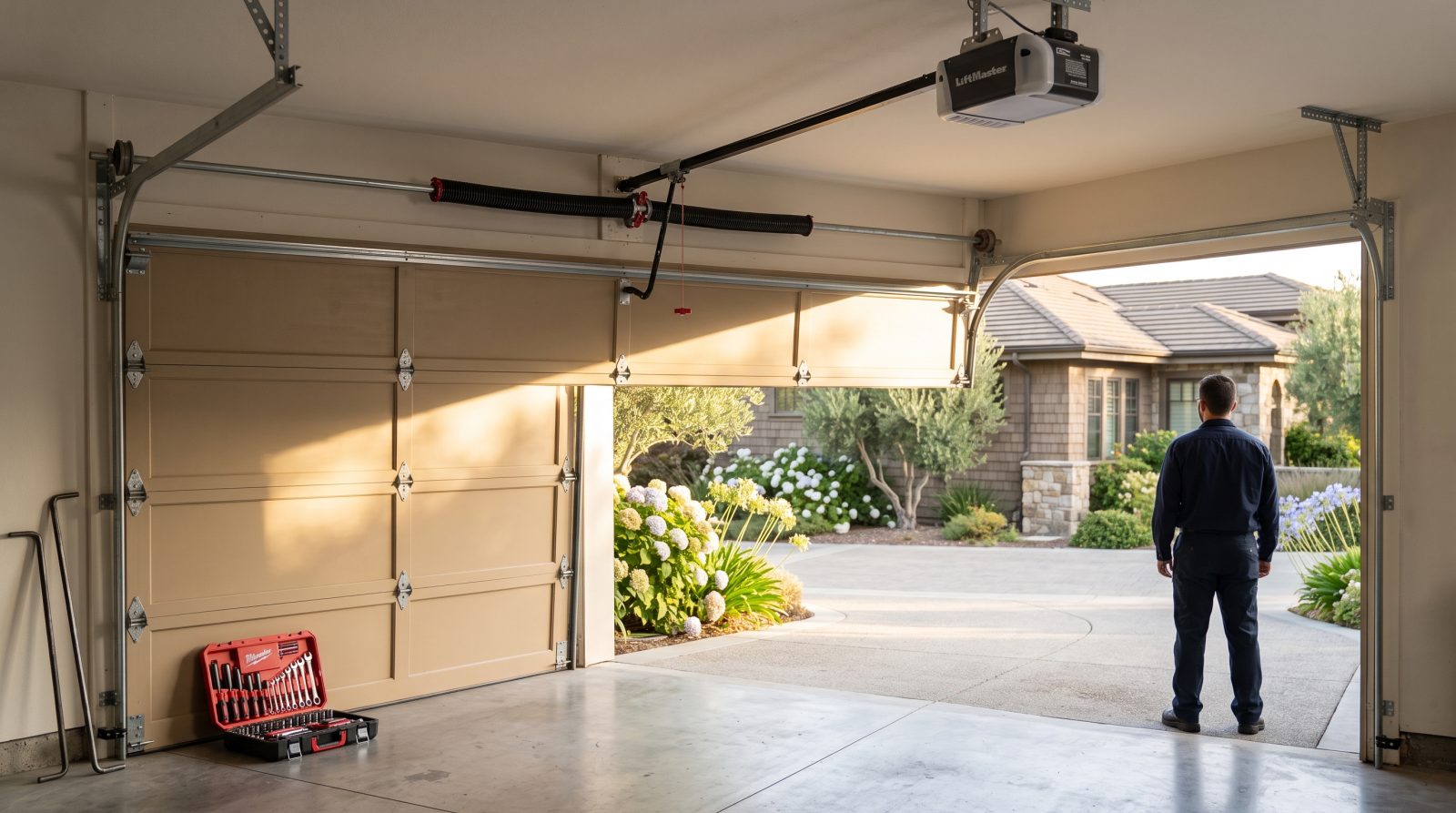
Common Garage Door Problems We Fix
Most garage door failures fall into a handful of categories, and the good news is that nearly all of them are repairable — you rarely need a whole new door. The trick is correctly diagnosing which component actually failed, because a door that 'won't open' can be a snapped spring, a stripped opener gear, a blown capacitor, or simply a misaligned safety sensor. Guessing wrong wastes money on parts that were never the problem. On-site diagnosis is the whole point of a mobile visit: we test the door under real conditions in your garage, not from a description over the phone.
Sacramento's climate adds its own wear pattern. Long, hot Central Valley summers bake the lubricant out of rollers and hinges, while the damp, foggy winter stretch encourages surface rust on springs and track. The result is a lot of doors that work 'okay' for years and then fail fast once the metal fatigues. Catching the early symptoms — grinding, jerky travel, a door that bounces at the bottom — usually means a smaller, cheaper repair than waiting for a hard failure.
- Broken or worn torsion and extension springs (the most common cause of a door that won't lift)
- Door off its tracks, crooked, or stuck partway open or closed
- Opener that hums but won't move, or won't respond to remote or wall button
- Loud grinding, squealing, or banging from rollers, hinges, or bearings
- Frayed or snapped lift cables, and drums that have unwound
- Doors that reverse on their own due to misaligned or dirty safety sensors
- Bent panels, cracked sections, or a door that no longer seals at the bottom
Broken Spring Repair — The #1 Call
If your door suddenly feels like it weighs a thousand pounds, or the opener strains and gives up halfway, a broken spring is the likely culprit. The springs — not the motor — do almost all the work of lifting the door; the opener just guides it. A typical residential door cycles its springs thousands of times, and most are rated for a finite number of cycles, so failure is a question of when, not if. You'll often see a visible gap in a coiled torsion spring above the door, or hear a loud bang when it lets go.
Spring work is the part of garage door repair we most strongly urge homeowners not to DIY. A loaded torsion spring stores a serious amount of energy, and the winding bars can become projectiles if a fitting slips. We carry common spring sizes on the truck and replace them with the door supported and secured. When one spring on a two-spring system breaks, replacing both at the same time is standard practice — the second is usually near the end of its life too, and matching the pair keeps the door balanced.
- Signs of a broken spring: a visible gap in the coil, a loud bang, or a door that won't lift
- We replace torsion and extension springs and re-balance the door so the opener isn't overworked
- Both springs replaced together on dual-spring doors to keep travel even and extend life
- Springs are high-tension components — on-site professional replacement is far safer than DIY
Opener, Sensor, and Off-Track Repairs
When the door itself is fine but it won't respond, the problem is usually in the opener or its accessories. Dead remotes can be a battery, a lost programming code, or a worn logic board. A motor that hums without moving often means a stripped drive gear or a failed capacitor — both repairable without replacing the whole unit in many cases. And a door that starts down and immediately reverses is almost always the photo-eye safety sensors near the floor being misaligned, dirty, or sun-blinded — a quick fix that homeowners frequently mistake for a major failure.
Off-track doors are the other big category. A door jumps the track after a cable snaps, a roller shatters, or something bumps the door out of alignment. It's tempting to force it back, but a door that's off-track is unbalanced and can fall — this is one to stop using and have looked at. We re-seat the door, replace the failed rollers or cables, check the track for bends, and confirm the door travels smoothly end to end before we leave. Because we're mobile, we handle all of this in your garage in a single trip whenever the parts are standard.
- Opener fixes: remote reprogramming, gear and capacitor replacement, sensor realignment, wall-button issues
- Door reverses on closing? Usually a quick sensor cleaning or realignment, not a new opener
- Off-track and snapped-cable repairs, with the door secured before any work begins
- Roller, hinge, and bearing replacement to quiet a noisy, grinding door
How Mobile Repair Works in the Sacramento Area
Everything we do is built around coming to you. You describe the symptoms, we arrive at your home, and the technician diagnoses the door on the spot rather than working from a guess. The repair truck carries the parts that cover the large majority of common failures — springs, rollers, cables, sensors, and opener components — so most jobs are finished in the same visit instead of scheduling a return trip for parts. When something genuinely needs a special-order part, you'll know exactly what it is and why before anything moves forward.
We cover the broader Sacramento region, including the city neighborhoods like East Sacramento, Land Park, Tahoe Park, and Natomas, plus the surrounding communities — Elk Grove, Roseville, Rancho Cordova, Citrus Heights, Folsom, and the Arden-Arcade area. Same-day service is available for many repairs, and because we're mobile there's no extra leg of you hauling a door anywhere. If you're not sure whether something is worth a service call, request a free quote and describe what the door is doing — clear advice up front beats an unnecessary trip.
- We come to your home and diagnose the door on-site — no storefront visit required
- Truck-stocked common parts mean most repairs are completed in a single trip
- Same-day service available for many repairs across the Sacramento area
- Serving Sacramento and nearby cities: Elk Grove, Roseville, Folsom, Rancho Cordova, Citrus Heights, Arden-Arcade and more
Repair Costs and What Drives Them
Garage door repair pricing depends mostly on which part failed and how much labor the fix takes. As a general industry guide, sensor realignment and minor adjustments sit at the low end, roller and hinge replacement in the middle, and spring or cable systems toward the higher end because of the parts and the tension-handling involved. Opener repairs vary widely — a remote or capacitor is modest, while a full motor or logic board replacement costs more. These are industry ranges, not quotes; your actual price depends on the exact components, the door type, and what we find on inspection.
The most cost-effective move is usually to address the real failure rather than the symptom, and to fix small issues before they cascade. A worn roller left alone chews up its track; a fraying cable left alone snaps and throws the door off its rails; a single broken spring left alone overworks the opener until that fails too. A proper on-site diagnosis tells you the true scope so you can decide with full information. We'll always explain what's failing, what's optional maintenance versus a real safety issue, and give you a straight answer on whether a repair or replacement makes more sense for your specific door.
- All figures here are general industry ranges — not a quote for your door
- Springs and cables sit higher due to parts plus the tension involved; sensors and adjustments are lower
- Fixing small issues early prevents larger, more expensive cascading failures
- Request a free quote and we'll explain the real scope before any work begins